
How to Choose Genuine Alligator Shoes For Men for Business Wear — Part 2

Share
How to Choose Genuine Alligator Shoes for Men for Business Wear: Part 2
Genuine alligator shoes for men are most readily recognized by a comparatively regular, balanced belly-scale pattern, although surface appearance alone cannot establish authenticity.
Start with the Correct Alligator Leather
Business shoes require more than a reptile pattern pressed into leather. Genuine alligator leather comes from an alligator hide, while embossed or printed leather only imitates the scale layout. Crocodile is a different material with different scale geometry and should not be treated as another name for alligator.
On a genuine alligator belly cut, the scales commonly appear orderly and symmetrical from one side of the panel to the other. A visible umbilical scar may also appear on the belly. Crocodile leather often varies more by species and may show visible sensory pores, known in the trade as integumentary sense organs or ISOs. These features can support a visual assessment, but one surface trait should not be treated as proof of species.
For a serious purchase, ask about the species identification used by the supplier or tannery. Internal species codes, stamps, and traceability records can be more useful than judging the scales alone, but marking systems vary by jurisdiction and brand practice. Documentation for legal trade also matters: CITES-related paperwork demonstrates trade compliance, not by itself that a particular shoe is genuine alligator.
Inspect the Belly Pattern for Business Proportions
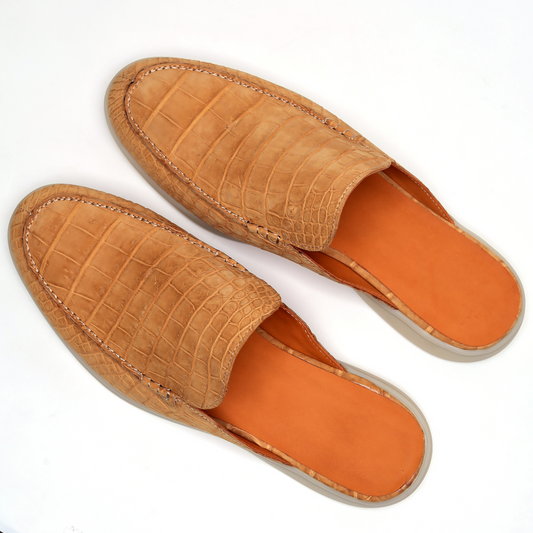
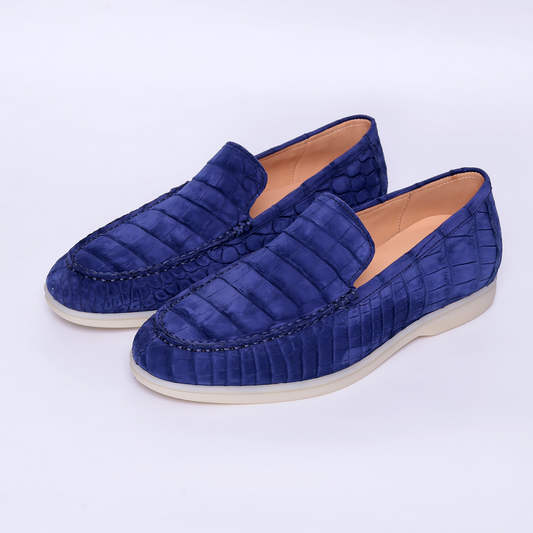
The central belly area is commonly chosen for dress shoes because its scales are comparatively regular and lie relatively flat. That layout gives a toe box or vamp a controlled visual rhythm, which is useful under tailored trousers and in conservative offices. A side or flank section can have more variation in scale size and shape, so the shoe may look less balanced across its most visible panels.
At CrocodileViet, pattern planning for business shoes centers on the sections that provide stable scale proportions and a flatter surface. The reason is practical: the vamp and toe receive the most visual attention, and a balanced scale layout makes the left and right shoes read as a pair rather than as two unrelated pieces.
Look closely at how the scales travel across both shoes. The pair does not need to be mirror-identical, because each hide is organic, but the scale direction, approximate size, and visual weight should be deliberately coordinated. Abrupt changes in scale size across the toe or a heavily mismatched pair can make a formal shoe look assembled from unrelated panels.
Use These Decision Factors at the Fitting and Inspection Stage
| Factor | What to inspect | Why it matters for business wear |
|---|---|---|
| Species identity | Alligator-specific documentation, traceability marks, and a surface pattern consistent with alligator | It separates genuine alligator from crocodile and from embossed substitutes. |
| Hide grade | Defects, scars, holes, scale damage, and the usable area of the hide | Grade affects the appearance and cutting options, not the species and not automatically the shoe’s durability. |
| Scale matching | Scale size, direction, and visual weight across both shoes | Coordinated panels give the pair a measured appearance beneath business clothing. |
| Construction | Upper shaping, lining, sole attachment, heel stability, edge finishing, and flex points | These features influence comfort, support, and how the shoes perform during working hours. |
| Handwork | Stitch consistency, skived joins, panel transitions, and finishing around the toe and heel | Handwork should improve the fit and panel control rather than serve as an unverified label. |
| Usable area | Whether the hide provides enough clean, well-positioned leather for both uppers | A larger visible scale is not useful if defects force awkward joins on the toe. |
Understand Hide Grade Without Treating It as a Durability Score
Alligator grading labels are not standardized worldwide. One tannery may use numbered grades, while another may use letters, zones, or its own descriptions. Some systems divide the hide into quadrants and assess the number and location of defects. In practice, grade usually describes blemishes, usable area, and cutting potential rather than proving authenticity.
A higher visual grade may provide cleaner belly panels for a pair of luxury alligator dress shoes, but it does not automatically mean that the finished shoe will resist wear better. Durability also depends on the leather’s thickness, tanning and finishing choices, pattern placement, lining, sole construction, reinforcement, and how the shoes are worn and stored.
For that reason, ask the seller to explain the grading system being used instead of assuming that a number has the same meaning across suppliers. A hide with a small scar in a hidden cutting area may work better for a particular pattern than a larger hide with defects across the toe position.
Check Construction, Not Just the Surface
Alligator scales can attract attention, but a business shoe still has to support the foot and hold its shape. Examine whether the vamp follows the foot without excessive wrinkling, whether the heel sits squarely, and whether the sole attachment is clean around the perimeter. The lining should feel smooth at the heel and along the topline, where rough edges can cause irritation during a full workday.
Handmade alligator shoes may involve hand-controlled cutting, skiving, joining, edge finishing, or other manual operations, but the word “handmade” does not describe one universal construction method. Ask which operations are performed by hand and how they affect the shoe. Hand-controlled cutting is valuable when it positions the most regular scales on the visible sections and keeps defects away from high-stress or high-visibility areas.
At our workshop, the reason to control the cutting pattern in this way is not simply to display a larger scale. It helps preserve the panel’s flatness, coordinate the two shoes, and reduce visually distracting joins across the toe and vamp. The final assessment should still include the sole, lining, stitching, and internal shaping.
Fit: Measure the Foot You Actually Have
Alligator leather may soften with use, but it should not be selected on the assumption that a tight shoe will stretch into the correct size. Start with the foot length and width, then account for instep height, toe shape, and any difference between the left and right foot.
- Length: Measure from the back of the heel to the longest toe while standing. Compare that measurement with the maker’s own size chart rather than converting by memory.
- Width: Record the broadest part of the forefoot. A standard-width last can feel restrictive even when the length is correct.
- Wide fit: Ask whether the design is made on a wider last or whether only the upper is cut wider. These are not the same adjustment.
- Instep: Measure around the highest part of the foot. A high instep may need additional upper volume, while a low instep can leave excess space and cause heel movement.
- Toe shape: Compare the last with your natural toe spread. A pointed business shoe reduces usable toe space even when the stated length matches.
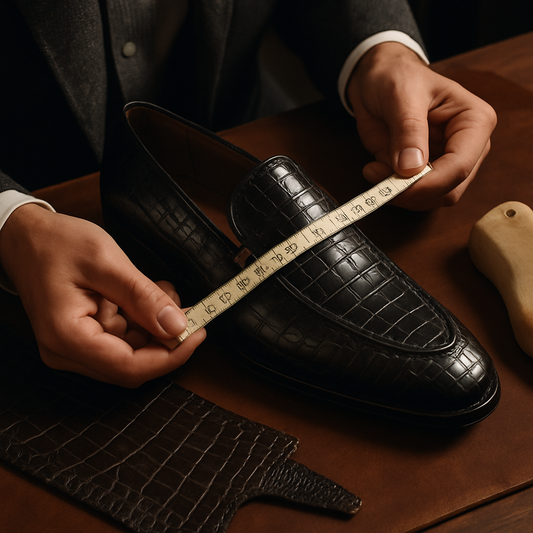
EU, US, and UK labels are not perfectly interchangeable between makers. Request the brand’s conversion information and send measurements in centimeters or millimeters. Remote measurement should be treated as an equally valid route to a good fit, not as a lesser substitute for trying shoes in person. Clear photographs of the foot, a tracing, and measurements of length, forefoot width, and instep can help a workshop assess the appropriate last. For in-person fitting, wear the socks and use the type of footbed you expect to wear at work.
Price Depends on More Than the Alligator Label
The price of alligator leather shoes reflects several separate inputs:
- the alligator species and the source of the hide;
- hide grade, defect distribution, and usable belly area;
- the amount of clean leather needed to cut a matched pair;
- scale size and the difficulty of placing the pattern on the last;
- lining, insole, outsole, heel, and other construction materials;
- the degree of manual cutting, skiving, stitching, and finishing;
- custom sizing, special lasts, and remote fitting adjustments.
A lower price does not identify a substitute, just as a higher price does not prove better materials or workmanship. Ask what leather section is used, how the pair is matched, which construction method is included, and what fitting service is available. Those answers are more informative than a generic “luxury” label.
Care for Alligator Shoes in a Working Wardrobe
After wearing the shoes, wipe the surface with a dry, soft cloth to remove dust and skin oils. Keep the cloth moving lightly with the direction of the scale rather than scrubbing across raised edges. Use a shoe tree that supports the shape without forcing the vamp upward or stretching the instep.
If a mark requires more than dry wiping, use only a barely damp cloth as a last resort and test an inconspicuous area first. Excess moisture can affect the finish and may leave uneven darkening between scales. Avoid household oils, alcohol-based cleaners, abrasive brushes, and untested creams. Conditioning should be based on the leather’s appearance, finish, and maker’s instructions rather than a fixed calendar schedule.
Let damp shoes dry at room temperature away from direct heat. Rotate them with another pair when possible, particularly if they are worn during long office days or commuting. Store them in a breathable shoe bag where the scales will not rub against rough surfaces.
Styling Genuine Alligator Shoes for Work
Conservative office
- Pair black alligator leather shoes with charcoal, navy, or medium-gray tailoring.
- Use a plain shirt, restrained tie, and a belt with a compatible level of formality.
- Choose a closed-lacing shape when the workplace favors traditional dress codes.
Client meetings and presentations
- Use dark brown or black footwear with a navy or charcoal suit when the office permits visible exotic leather.
- Keep the shoe’s toe shape clean and the scale layout controlled so the footwear supports, rather than competes with, the suit.
- Coordinate the leather’s visual weight with the watch strap or belt without requiring an exact color match.
Business-casual settings
- Wear a less formal alligator loafer or derby with tailored trousers, a knitted polo, or an unstructured jacket.
- Let the shoe color relate to the trousers and belt while allowing moderate contrast.
- Avoid combining several highly patterned garments with a prominently scaled shoe.
The most reliable choice is the pair that fits your foot, suits the workplace’s dress expectations, and shows controlled alligator scale placement. Pattern regularity, species documentation, construction, and measurable fit should carry more weight than a sales label.
View CrocodileViet’s alligator leather shoe collection and contact us through WhatsApp for size measurements, fit questions, or material details. We can discuss the foot dimensions and business setting before recommending a suitable pair.