
Chanel’s Chocolate Alligator Shoes Put Brown Exotic Leather in Focus

Share
Chanel’s Chocolate Alligator Shoes Put Brown Exotic Leather in Focus
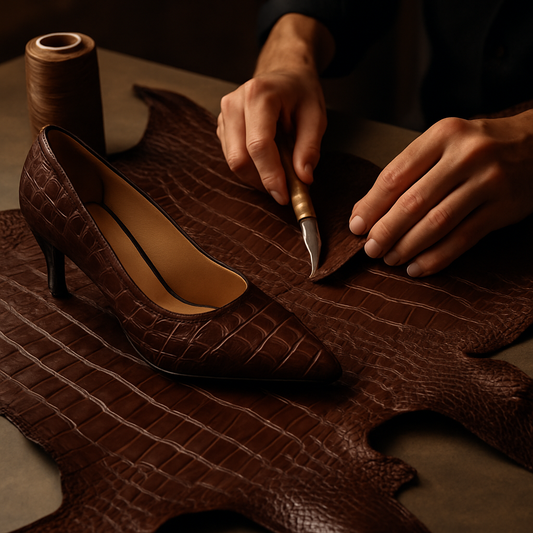
Chocolate alligator leather is brown-finished leather from American alligator or another alligator source, with “chocolate” describing the color rather than the species, hide section, or grade.
The Chanel Spring 2026 shoes referenced in this trend may draw attention to brown alligator shoes, but available information does not verify the specific pair’s material or provenance. That distinction matters because a chocolate-colored shoe may use alligator, crocodile, calfskin, or an embossed substitute. The color alone cannot identify the leather.
What “chocolate alligator leather” actually means
“Chocolate” usually indicates a deep brown color or finish. It does not establish whether the hide is from an alligator or crocodile, and it does not tell you whether the leather came from the belly, flank, tail, or another section.
American alligator (Alligator mississippiensis) is a distinct species from crocodile. On alligator belly leather, the scales often look rounded or squarish and form a comparatively regular, balanced pattern. Crocodile belly scales can vary more by species and often show visible sensory pores, commonly called integumentary sensory organs or ISOs.
Scale appearance can support identification, but it is not conclusive by itself. Lighting, finishing, scale location, and photography can change how a hide appears. An umbilical scar is also often visible on alligator belly leather, while crocodile belly leather generally lacks that feature.
Belly cut is not a leather grade
A belly cut identifies the part of the hide used for the product. It does not automatically mean a particular quality level. Grading labels vary between suppliers and tanneries, so a seller’s “Grade 1” should not be treated as a universal industry definition.
One documented grading system evaluates the belly-and-flank midsection for defects and excludes the head and tail. In that supplier’s system, Grade 1 has no belly defects, Grades 2 through 4 indicate increasing clusters of defects, and Grade 5 is below Grade 4. Those numbers describe that supplier’s scale, not every alligator leather source.
For chocolate alligator leather, inspect the actual panel used on the shoe. Check whether the color is even across the vamp, whether the scales lie flat, and whether scars, pinholes, scratches, or irregular patches appear in visible areas. A higher visual grade can improve appearance, but visual grade is not the same as durability. Construction, leather thickness, lining, sole design, and use also affect service life.
How to assess brown alligator shoes before buying
| Decision factor | What to check | Why it matters |
|---|---|---|
| Species and material | Ask whether the shoe uses alligator, crocodile, embossed leather, or another material. | Brown color and scale embossing cannot establish species. |
| Hide placement | Confirm whether the visible vamp uses belly, flank, tail, or mixed panels. | Scale size and pattern change across the hide. |
| Surface condition | Look for open pores, scratches, scars, color breaks, and poorly aligned panels. | Visible defects affect the shoe’s appearance even when the leather is genuine. |
| Construction | Review sole attachment, stitching, lining, heel stability, and finishing around the edges. | Leather type alone does not determine how a shoe performs. |
| Documentation | Ask for supplier information and applicable trade documentation where required. | Crocodilian products may be subject to CITES controls and national regulations. |
Price factors for chocolate alligator leather shoes
The price of alligator leather shoes depends on more than the word “chocolate.” Relevant factors include the species, usable hide area, visible belly coverage, defect level, panel matching, leather thickness, tanning and finishing method, shoe construction, lining, sole material, hardware, labor, and the seller’s documentation and distribution costs.
Large, clean belly panels can require more selective hide use than shoes made from smaller or heavily divided sections. A darker brown finish may also involve additional coloring or surface treatment, although the appearance alone does not reveal the full process. Compare the actual shoe, not only a grade number or a product description.
International trade adds another practical consideration. American alligator is listed in CITES Appendix II in the cited supplier material, and international trade in crocodilian skins and products can require applicable permits or certificates. In the United States, covered skins generally also need a locked, non-reusable tag. CITES documentation supports lawful trade requirements; it does not, by itself, prove that a product is authentic.
Fit and sizing for alligator leather shoes
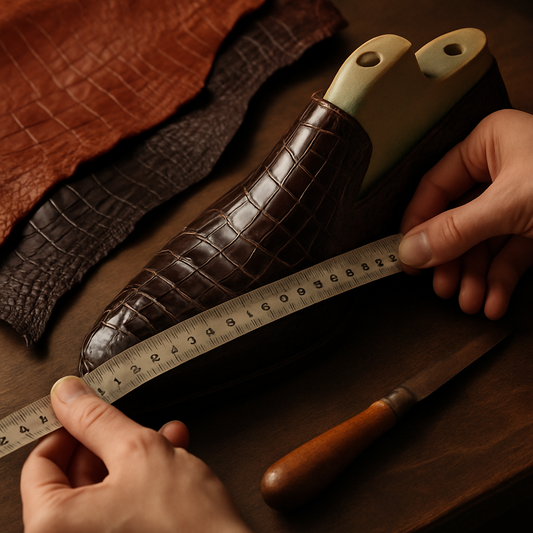
Exotic leather shoes should be fitted by foot length and width, not by size number alone. Compare the maker’s chart across EU, US, and UK sizing because the conversion can differ by last. Measure both feet from heel to the longest toe, then record the widest part of the forefoot.
Width and instep are especially important in structured dress shoes. A high instep may need more upper volume, while a wide forefoot may require a wide-fit last rather than simply going up in length. Increasing length to gain width can leave excess space at the heel and change how the vamp creases.
For remote measurements, send heel-to-toe length, forefoot width, instep circumference, and an outline of each foot if the maker accepts them. Include the socks or hosiery normally worn with the shoes. A remote measurement can improve the recommendation, but it does not replace a fitting when your feet differ substantially in size or shape.
Care for chocolate alligator leather
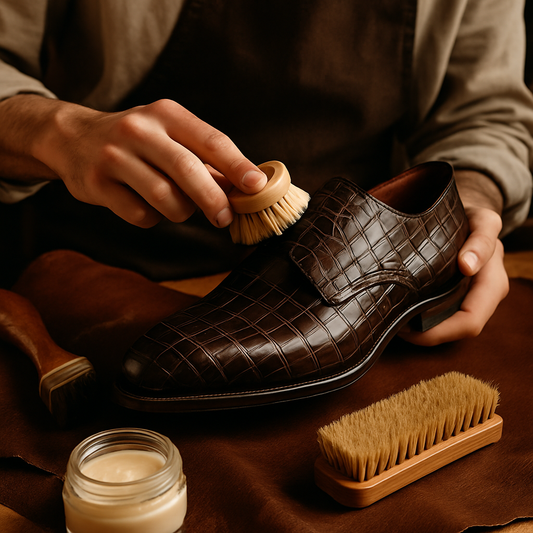
After wear, remove surface dust with a soft, dry cloth. That is the safest default for routine care because water, alcohol, household cleaners, and untested creams can change a colored exotic finish. Keep the shoes away from direct heat and allow them to dry gradually if they become damp.
Use shoe trees that support the shape without stretching the upper. Rotate pairs when possible so the leather can rest between wears. There is no useful fixed maintenance schedule for every owner: care depends on climate, frequency of use, perspiration, rain exposure, and the finish applied to the leather.
Before applying conditioner or polish, test it on a hidden area or ask the maker whether the product is suitable. A product that works on smooth calfskin may darken, cloud, or soften a chocolate alligator finish.
Styling brown alligator shoes
Chocolate brown works with navy, charcoal, cream, olive, mid-grey, and medium-to-dark denim. For business clothing, pair brown alligator shoes with a navy or charcoal suit and keep the belt, watch strap, or other leather accessories within a related brown family without demanding an exact color match.
With lighter trousers, the shoes become more visible, so a restrained shirt and jacket can keep the outfit balanced. A dark brown loafer can support smart-casual clothing, while a closed-lace style usually suits formal tailoring more readily. Keep the rest of the outfit’s textures controlled because the scale pattern already provides surface interest.
For another color-focused reference, read Navy Alligator Skin Shoes: Styling, Care and Buying Tips.
Frequently Asked Questions
Does chocolate alligator leather prove that a shoe is made from alligator?
No. Chocolate describes a brown color or finish, not a species. Confirm the material through the seller’s product information, hide description, and applicable documentation. Scale appearance alone is not proof of authenticity.
How can alligator belly leather differ visually from crocodile belly leather?
Alligator belly scales often appear rounded or squarish with a comparatively regular, balanced pattern. Crocodile patterns vary more by species and often show visible sensory pores, or ISOs. An umbilical scar is also often associated with alligator belly leather and is generally absent from crocodile belly leather, but these features should not be used as the sole identification method.
Is belly-cut alligator leather a specific grade?
No. Belly describes the hide section, while grading systems vary by supplier or tannery. Ask which grading scale is being used and what defects it measures instead of assuming that a number has the same meaning across sellers.
What measurements should I provide when ordering brown alligator shoes remotely?
Provide heel-to-toe length, forefoot width, instep circumference, the EU/US/UK size you normally wear, and whether you need a wide fit. Foot outlines and notes about bunions, high instep, or different-sized feet can also help the maker assess the likely fit.
Browse CrocodileViet’s alligator leather shoes collection to compare available styles and materials. For measurements or product questions, contact CrocodileViet on WhatsApp.