
How to Choose Matte Crocodile Leather for Business Wear

Share
How to Choose Matte Crocodile Leather for Business Wear
Matte crocodile leather is suited to business wear when you want a low-glare surface that keeps the natural scale pattern visible without the reflective finish of shiny crocodile leather.
What “matte” means on crocodile leather
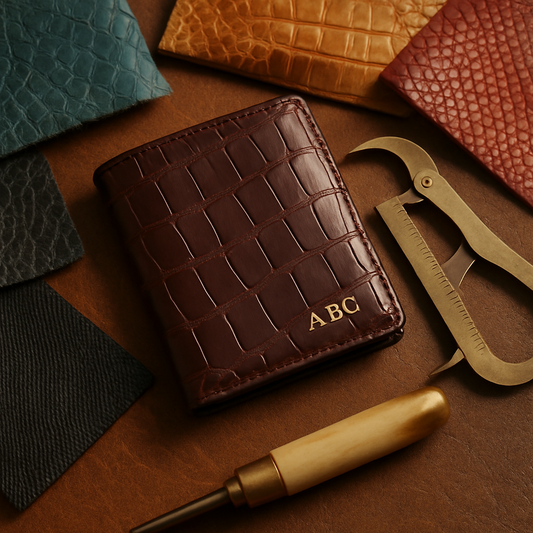
“Matte” describes the appearance of the finished surface rather than a separate crocodile species or hide section. Compared with a glossy finish, matte crocodile leather reflects less light, so the scale layout, natural color variation, and small surface differences are easier to see at close range.
A matte finish can work well for office shoes, belts, briefcases, watch straps, and other business accessories because it looks controlled under indoor lighting. It is also less visually dominant than a high-gloss surface, which may be useful with conservative tailoring. The finish does not remove the natural structure of crocodile leather: scale size, pattern regularity, pores, and any approved natural marks still depend on the hide and the cutting area.
Matte should not be confused with nubuck. Nubuck is made by buffing the surface to create a nap, while matte crocodile leather retains the recognizable scale surface. If the leather feels velvety or shows directional shading when brushed, ask the maker to identify the finish before ordering.
Start with the crocodile hide, not the finish
A matte surface can soften reflections, but it cannot correct poor scale placement, unsuitable cutting, or excessive defects. For business wear, inspect these points first:
- Species and origin: “Crocodile” is a broad trade description for leather from crocodilian species. Species-level labeling matters because regulatory status can differ by species and origin.
- Cutting area: Belly leather is generally flatter and more symmetrical than flank or tail sections. That makes it more practical for visible panels where the scale layout needs to read as regular and balanced.
- Pattern control: Look for scale rows that suit the shape of the item. A narrow belt, shoe vamp, or wallet panel needs a different layout from a large briefcase panel.
- Surface condition: Check for cracks, open damage, deep scars, or irregular marks in the area that will remain visible after construction.
- Scale size: Medium or smaller scales can look more proportionate on office shoes and narrow accessories, while larger scales may suit a broad bag panel. The right choice depends on the dimensions of the item.
At CrocodileViet, we use belly sections for visible business-wear panels when the design calls for a flatter and more balanced scale arrangement. This gives the maker better control over how the rows run across a shoe vamp, belt, or bag flap; it is not a claim that every belly section has the same visual grade or surface condition.
How to assess the crocodile pattern
Do not identify crocodile leather from the overall shape of the scales alone. Crocodile and alligator leather can both show squarer belly scales and rounder flank scales, so scale shape by itself is an unreliable shortcut.
A more useful visual cue is the presence of small sensory pores, also called integumentary sensory organs or ISOs. On crocodile leather, these pores may appear as small dots in the center of the scales. They can help distinguish crocodile from alligator, but one sensory feature should not be treated as conclusive proof of authenticity. Species labeling, traceability, supplier documentation, and physical inspection should be considered together.
Crocodile patterning also varies by species. Two hides can both be genuine crocodile while showing different scale proportions, pore visibility, color response, or belly symmetry. For a business item, compare an actual leather sample with the finished design rather than choosing from a color name alone.
Matte finish versus a glossy finish for the office
| Decision factor | Matte crocodile leather | Shiny crocodile leather |
|---|---|---|
| Light reflection | Lower reflection makes the surface read quietly in office lighting. | Higher reflection makes the scale pattern more noticeable from a distance. |
| Visible texture | Scale structure and natural variation remain easy to inspect at close range. | Reflections can make the surface look smoother from some angles. |
| Business setting | Often suits conservative tailoring, daily meetings, and understated accessories. | Can suit evening business events or outfits designed around a more pronounced accessory. |
| Color impression | Usually reads with softer contrast and less surface glare. | Can make dark colors appear deeper and more reflective. |
| Maintenance concern | Dry dust and handling marks may be easier to notice on low-glare surfaces. | Finger marks and uneven reflection can be more apparent on a glossy surface. |
Neither finish determines durability on its own. Hide selection, usable area, construction, edge work, stitching, reinforcement, and how the item is used all affect practical service life. A visually high-grade hide is not automatically stronger than every lower visual grade.
Understand grading before comparing prices
Crocodile grading commonly focuses on visible defects in the main pattern area. Suppliers may divide that area into four quadrants and assess how many blemishes appear in the sections used for cutting. Fewer visible defects in the key cutting area generally support a higher visual grade.
Grading labels vary by supplier and tannery. Terms such as “first grade” or “highest grade” should therefore be read as that supplier’s classification, not as a universal industry scale. They usually describe the appearance of the important cutting area, not simply the size of the hide.
When comparing a matte crocodile item, ask for the concrete basis of the quoted price:
- the crocodile species and documented origin;
- the amount of usable belly or other selected leather;
- the number and consistency of visible scale rows;
- the hide’s visual grade and how the supplier defines it;
- the amount of leather discarded to achieve the layout;
- pattern matching across panels;
- lining, reinforcement, hardware, and edge construction;
- the amount of handwork required for assembly and finishing.
A large hide can still have limited usable area if defects fall in the section required for the design. Conversely, a smaller hide may be suitable for a belt or shoe panel if its belly pattern fits the dimensions and the visible area is well controlled.
Choose the right matte crocodile item for business wear
Office shoes
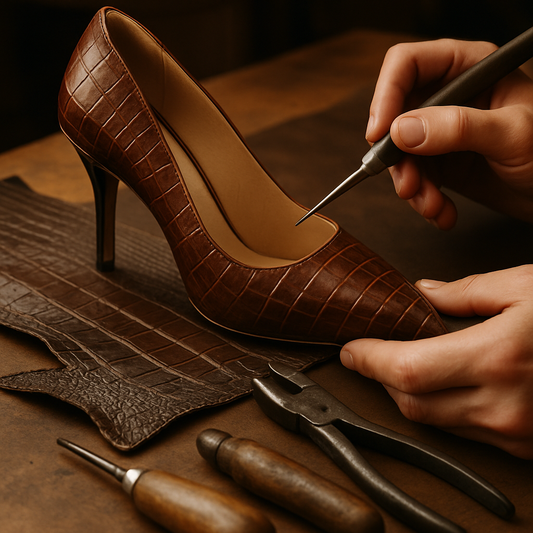
- Choose a pattern whose scale size fits the vamp rather than ending abruptly near the toe.
- Check whether the pattern is centered across the pair and whether the left and right shoes have a compatible visual rhythm.
- For a wide foot, ask how the pattern expands across the forefoot; a narrow central panel can make the sides appear visually crowded.
- For a high instep, provide measurements or ask about the upper construction before ordering, since the correct length alone may not provide enough volume.
Belts
- Look for a longitudinal layout that does not place a large irregular scale directly at the buckle fold.
- Confirm the finished width, buckle width, and adjustment range together.
- For formal trousers, a narrower belt may sit more cleanly through the loops; for wider loops or less formal tailoring, a broader belt can be proportionate.
Briefcases and work bags
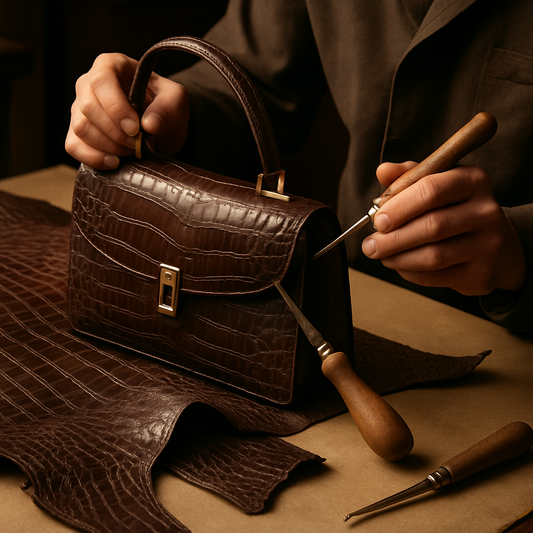
- Ask how the belly pattern will be placed on the front flap or main exterior panel.
- Check the weight of the leather, lining, handle construction, and base reinforcement rather than judging the item by the outer finish alone.
- For daily commuting, confirm how the bag is supported when full and whether the strap or handles suit the intended load.
Fit and measurements matter as much as appearance
For shoes, provide your usual EU, US, or UK size, but do not treat those labels as interchangeable across makers. A useful remote measurement set includes foot length, forefoot width, heel width, and instep circumference. Measure both feet and report which one is larger. A foot with a wide forefoot or high instep may need a different last or construction even when the stated size is familiar.
In-person fitting allows you to check toe clearance, heel movement, instep pressure, and whether the upper creases in the intended place. Remote measurement remains equally important when trying on is not available; photographs of the foot outline and a measurement beside a ruler can add context, but they do not replace accurate dimensions.
For belts, provide the measurement from the buckle’s fastening point to the hole you use most often, not only your trouser size. For bags, specify the device or documents the interior must hold, along with the handle drop or strap length you need for your usual clothing.
Care for matte crocodile leather
Keep the item away from prolonged moisture, direct heat, and compressed storage. After use, wipe dust with a clean, dry cloth. A slightly damp cloth should be a last resort for a localized mark, followed by air drying away from heaters and strong sunlight.
Do not apply polish, oil, wax, or conditioner merely because the surface looks dry. Products made for smooth cow leather may darken crocodile scales, alter the matte appearance, or leave an uneven film. If conditioning becomes necessary, ask the maker which product is compatible with the specific finish and test it on an unseen area first.
Store shoes with their shape supported, keep belts loosely rolled rather than sharply folded, and avoid placing heavy objects on bags. Inspect the item after exposure to rain or spills instead of rubbing aggressively while the leather is wet.
Documentation and international purchase
Many commercially used crocodilians are listed under CITES Appendix II. Depending on the species and transaction, international trade can require import, export, or re-export documentation. CITES documents address trade compliance; they do not by themselves prove that a particular item is authentic.
For an international order, request the species information and ask which documents apply to the destination and transaction type. Items made from readily recognizable crocodilian skin pieces may require appropriate documentation, while personal-effects exemptions can be treated separately. Requirements should be checked for the specific shipment rather than assumed from the word “crocodile” alone.
Questions to ask before ordering
Will matte crocodile leather develop a patina?
It may change in color and surface character through handling, light exposure, and contact with oils from the skin. The result depends on the finish, color, use, and care, so a maker should not promise one fixed patina pattern.
Does a higher visual grade mean the item will be more durable?
Not necessarily. Visual grade mainly concerns defects and appearance in the cutting area. Construction, leather thickness, reinforcement, stitching, hardware, and use have separate effects on durability.
How can I confirm that the leather is crocodile?
Ask for species-level labeling, origin information, and applicable trade documents. Sensory pores can be a useful visual clue, but they should be assessed with the documentation and the finished construction rather than used as the only test.
What should I compare if two matte crocodile belts have different prices?
Compare the usable pattern area, grade definition, scale matching, belt width, backing, buckle, edge construction, handwork, and documentation. The word “matte” identifies the surface appearance but does not explain the full cost.
Choose a business-wear format
For matte crocodile shoes made for office and formal settings, view the available styles at CrocodileViet’s shoe collection. You can also contact CrocodileViet through WhatsApp to discuss measurements, pattern placement, finish, and documentation for your intended use.