
How to Choose Alligator Wallet Men for Business Wear

Share
How to Choose a Men’s Alligator Leather Wallet for Business Wear
A business-appropriate men’s alligator leather wallet is usually made from belly leather because its comparatively regular, rectangular scales lie flatter, fold more cleanly, and create a controlled appearance in a small format.
For office wear, client meetings, and formal travel, the goal is not simply to choose the most dramatic scale pattern. A useful wallet needs a panel layout that looks composed in the hand, carries the cards and notes you actually use, and fits the pockets of your work trousers or jacket without creating a bulky outline. The hide section, belly grade, wallet dimensions, construction, and closure style all affect that result.
Start With the Belly Cut
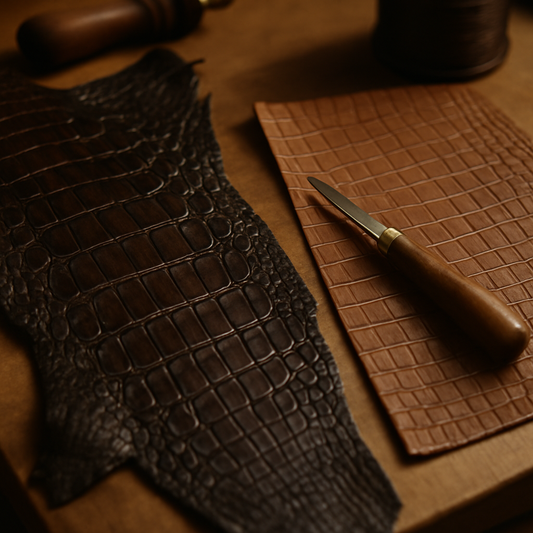
The belly is the key area to inspect on a men’s alligator leather wallet. Alligator belly leather has a more regular scale arrangement than many other hide sections, with broad scales arranged in a relatively even grid. This gives a business wallet a quieter surface than a back or tail panel, where raised osteoderms and more irregular scales can dominate the design.
At CrocodileViet, belly panels are relevant to wallet design because the flatter scales help control the visual layout across card slots, folds, and exterior faces. A balanced scale field can keep one side of a bifold from looking much busier than the other, while the leather’s folding behavior is better suited to compact goods than thick, heavily structured sections.
Look at where the largest scales fall. On a bifold, a centered arrangement on the exterior panel can look orderly with a suit or tailored trousers. On a card holder, smaller scales may be more practical because the visible panel is narrow. Scale size is not a simple ranking of better or worse; it should suit the wallet’s dimensions and the amount of visual activity you want in business settings.
Understand Alligator Belly Grades Before Comparing Prices
Alligator hides are commonly graded according to the belly area, often on a 1-to-5 scale. In grading systems using this convention, Grade 1 indicates a belly with no visible defects, while lower grades reflect a growing number or more prominent placement of scars, scratches, shading marks, or scale deformities.
The back and tail do not count against this belly grade. This matters because a buyer might see a more textured area elsewhere on a hide and assume it determines the stated grade. For a wallet made from belly leather, the condition of the actual panel used for the exterior matters more than an unrelated section.
Grade labels and inspection standards can vary between suppliers and tanneries, so a number alone is not enough for a meaningful comparison. Ask which section was graded, whether the visible wallet panel has marks near its center or fold, and how the maker has positioned any natural characteristics. A minor mark near an edge may have less effect than one positioned in the middle of an exterior panel.
| Decision factor | What to examine | Why it matters for business wear |
|---|---|---|
| Belly grade | Scars, scratches, shading, and scale shape on the visible panel | A cleaner central panel generally reads more restrained with formal clothing. |
| Scale layout | Scale size, symmetry across the panel, and placement around folds | A controlled layout avoids a visually crowded exterior. |
| Usable hide area | The amount of clean belly leather available for matched panels | Larger clean areas give the maker more options for consistent panel placement. |
| Construction | Fold thickness, edge finishing, lining arrangement, and slot capacity | These details determine pocket bulk and daily usability. |
| Handwork | Panel alignment, cutting precision, stitching execution, and edge work | Handwork affects how neatly the wallet functions at stress points and folds. |
Choose a Format That Fits Your Workday
A wallet for business wear should be sized around your actual carrying habits rather than a general idea of luxury. Count your daily cards, identify whether you carry banknotes, receipts, or business cards, and decide whether you need coin storage. An overfilled wallet can strain the fold and create unnecessary thickness regardless of the leather used.
For tailored trousers and suit jackets
- A slim bifold can suit someone who carries several cards and folded notes but wants the wallet to sit discreetly in an inside jacket pocket or front trouser pocket.
- A card holder can work for meetings, presentations, and payment cards where cash and receipts are limited.
- A longer wallet may be useful for those who carry unfolded currency or travel documents, though its length should be checked against the intended jacket pocket.
For commuting and business travel
- A zip-around format can keep cards, notes, and receipts contained during movement between airports, taxis, and meetings.
- Check the zipper path and interior depth before purchase. A wallet can have ample capacity but still be inconvenient if cards catch near the closure.
- If you are comparing a crocodile zipper wallet with an alligator leather wallet, confirm the stated species rather than treating the names as interchangeable. Alligator and crocodile are distinct crocodilian leathers, and the product label and documentation should identify the material accurately.
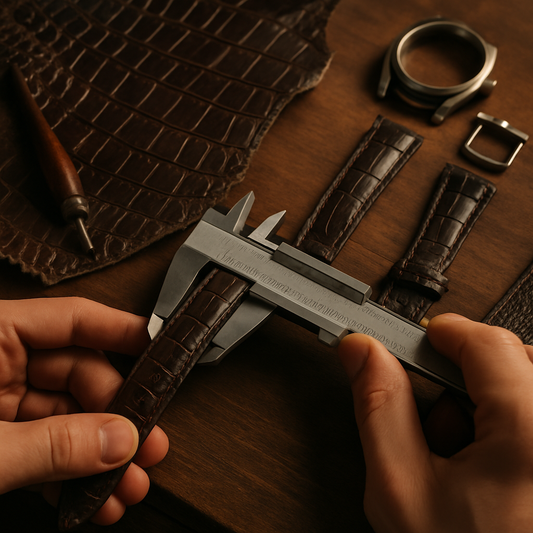
Request the wallet’s closed length, closed width, and thickness, then compare those figures with a wallet you already carry comfortably. Remote measurements deserve the same weight as an in-person pocket check: dimensions reveal whether a piece will fit your jacket, trouser pocket, or briefcase compartment before you commit.
Why Price Varies Between Men’s Alligator Leather Wallets
The price of an alligator leather wallet can reflect several specific inputs rather than a broad claim of “quality.” Species is one factor, because alligator leather must be identified and sourced as alligator rather than marketed loosely under a crocodilian label. Hide grade matters because cleaner belly areas allow more freedom in placing a visible panel. Usable belly area also matters: a maker needs enough uninterrupted leather to cut the required pieces without placing unwanted marks at the fold or center.
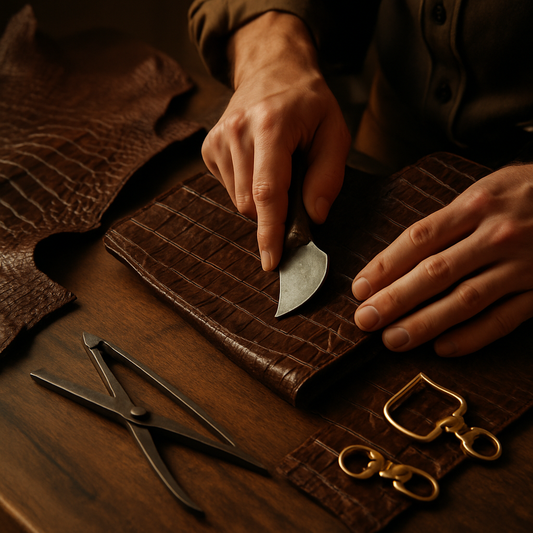
Scale matching can add further work. On a bifold, the exterior, interior trim, and card-slot components may require decisions about which scale sizes sit beside one another. Construction also affects cost: the number of card slots, lining pieces, edge finishing, fold reinforcement, and closure hardware changes the labor and material requirement. Handwork is relevant where it improves panel alignment, stitching around corners, and finishing on narrow edges.
Do not assume that a higher visual grade automatically means greater durability. A wallet’s service life depends on leather condition, tanning and finishing, construction, how heavily it is filled, and how it is used. Grade chiefly describes the visible character of the belly area.
Read Material Descriptions Precisely
“Alligator leather” or “alligator skin” is the accurate material description for this category. The shorter word “alligator” identifies the animal, while the wallet itself is made from its leather. Clear species wording is especially useful for buyers who want traceability paperwork or tags associated with commercial crocodilian leather.
CITES documentation concerns legal trade compliance for crocodilian materials. It should be part of a traceability discussion, but it does not independently establish every aspect of a finished wallet’s authenticity, construction, or grade. Review the stated species, seller documentation, and the product description together.
The terms full-grain and top-grain also describe different leather treatments. Full-grain leather retains the outermost surface of the hide. Top-grain leather has had that surface sanded or buffed to reduce imperfections and create a more regular appearance. Neither term replaces a species identification, belly-grade explanation, or inspection of the visible wallet panel.
Select a Business-Appropriate Colour and Scale Presence
For conservative workplaces, darker alligator leather tones such as black, deep brown, charcoal-toned grey, or muted navy can work with navy, grey, and charcoal suiting. These colours usually keep the scale pattern visible without allowing it to dominate the rest of the outfit.
For client dinners, creative offices, or less formal business wardrobes, mid-brown, burgundy-toned, or more visibly shaded leather can introduce more surface character. In these settings, the wallet can still look considered if the scale layout is controlled and the format remains compact.
A business wallet does not need to match a belt or shoes exactly. Instead, keep the overall leather direction coherent: black can sit comfortably with black footwear and darker tailoring, while brown tones can work with brown shoes, navy suits, olive trousers, and textured jackets. The wallet’s scale pattern is already a visual element, so a restrained colour often gives it more room to read clearly.
Care for an Alligator Leather Wallet Used Every Day
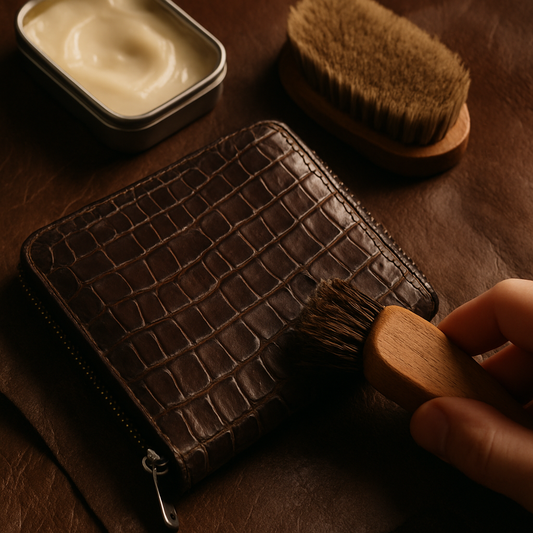
For routine care, wipe the wallet with a dry, soft cloth to remove dust and fingerprints. Let it air out after exposure to humidity, and avoid leaving it on a hot dashboard, near a radiator, or in direct sun for extended periods. Heat and excessive dryness can affect the leather finish and the flexibility of fold areas.
Use a slightly damp cloth only as a last resort for a localized mark, with minimal moisture and no soaking. Test any leather product on an inconspicuous area first, because finishes can react differently. Rather than following a fixed conditioning schedule, inspect the wallet’s surface and folds for dryness, stiffness, or changes in finish, then seek product-specific advice before applying conditioner.
Avoid overstuffing card slots and bill compartments. Extra pressure concentrates at the fold, stretches the lining, and can alter how the belly scales sit over time. Rotate bulky receipts out of the wallet, especially if it is carried in a rear trouser pocket.
Questions to Ask Before Buying
Which alligator leather section forms the exterior panel?
Ask whether the visible exterior is cut from the belly and where the panel sits within that area. This helps you assess scale regularity, folding behavior, and the placement of any natural marks.
What are the closed dimensions and number of usable card slots?
Dimensions and capacity reveal more about daily suitability than photographs alone. Compare them with your current wallet and with the pocket or bag compartment where you intend to carry it.
How is the wallet described in its species and trade documentation?
Look for a clear alligator leather description and appropriate traceability information for legal crocodilian leather trade. If a listing uses crocodile and alligator interchangeably, request clarification before comparing it with a men’s alligator leather wallet.
Choose the Wallet Around Your Actual Business Routine
The strongest choice for business wear is one whose belly scale pattern, grade, dimensions, and construction support the way you carry it. A compact card holder may suit a meeting-heavy schedule, while a bifold can serve someone who needs cash and multiple cards. In either case, a properly selected belly panel gives an alligator leather wallet a composed surface without asking the accessory to compete with the rest of your workwear.
View CrocodileViet’s wallet collection to compare available formats and leather layouts. For dimension, material, or carrying-capacity questions, contact CrocodileViet via WhatsApp before choosing.