
How to Choose Crocodile Watch Band for Business Wear

Share
How to Choose a Crocodile Watch Band for Business Wear
For business wear, a crocodile watch band cut from a clean belly area usually gives the most controlled scale presentation on the narrow surface of a watch strap.
A watch strap is the standard horology term, although “crocodile watch band” is widely used by buyers. For office settings, client meetings, formal dinners, and professional travel, the aim is not to find the most dramatic hide pattern. It is to choose a genuine crocodile leather strap with balanced scale placement, a proportionate width for the watch case, and a finish that works with the watch and the clothes worn around it.
Start With Genuine Crocodile Leather, Not an Embossed Pattern
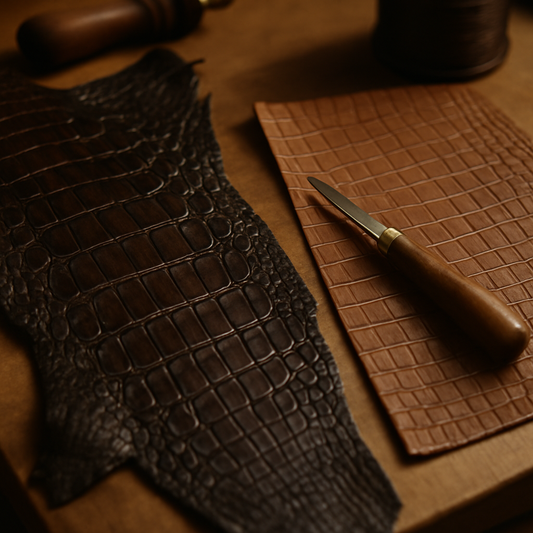
Genuine crocodile leather has a naturally irregular scale pattern: scale shapes, row spacing, and transitions vary across the hide. Embossed “croc” leather uses a repeated stamped design on another leather and is a different material. A repeating pattern may look tidy from a distance, but it does not have the natural variation of crocodile skin.
Crocodile can vary substantially by species, including differences in scale shape and spacing. Visible sensory pores, often called ISOs, may be present on crocodile leather. They are useful details to inspect, but one feature alone does not establish authenticity. Assess the overall scale structure, the natural variation in the hide, the seller’s species information, and applicable trade documentation together.
Buyers sometimes compare a crocodile watch strap with an alligator watch strap or an alligator leather watch band. These are distinct materials. Alligator belly leather commonly shows a more regular, balanced scale arrangement, while crocodile often shows greater variation. An alligator may also show an umbilical scar that crocodile generally lacks, though that detail should be treated as part of a broader assessment rather than a standalone test.
Why the Belly Area Matters on a Business Strap
A watch strap uses only a narrow part of a hide, so the cutting area matters as much as the species name. The belly is generally the most usable area for watch straps because it can provide a cleaner, more consistent field of scales for the strap’s visible face.
At CrocodileViet, we assess the intended strap-cutting path across the belly before cutting because a narrow strap leaves little room to disguise pits, scars, uneven grain, or an awkwardly placed scale transition. A well-positioned cut helps keep the visual rhythm balanced from the lug end to the buckle end, particularly on straps worn with business clothing.
For this use, inspect both strap halves rather than judging only the long piece. The two halves do not need to mirror each other exactly—natural leather does not work that way—but their scale character should look intentional when viewed on the wrist.
Choose Scale Character for the Watch, Not Just the Hide
Business wear usually benefits from a strap whose scales support the watch rather than compete with it. Scale size should relate to the strap width and watch case dimensions. Large, high-contrast scales can overwhelm a slim dress watch, while a restrained scale field can look too quiet on a broad case. Neither direction is inherently better; the useful choice depends on proportion.
| Decision factor | What to inspect | Why it matters for business wear |
|---|---|---|
| Scale placement | Whether the scale rows sit coherently along each strap half | Creates a composed appearance at close conversational distance |
| Visible marks | Scars, pits, loose grain, or abrupt pattern interruptions | Narrow straps show surface defects more clearly than larger leather goods |
| Scale size | Its relationship to lug width and case diameter | Keeps the strap visually proportionate to the watch |
| Colour and finish | Depth of colour, surface sheen, and how the finish reads in daylight | Helps the strap work with workwear rather than dominate it |
| Strap construction | Thickness, edge treatment, lining, buckle, and compatibility with the watch | Determines comfort, wrist profile, and practical daily wear |
Get the Width and Length Right
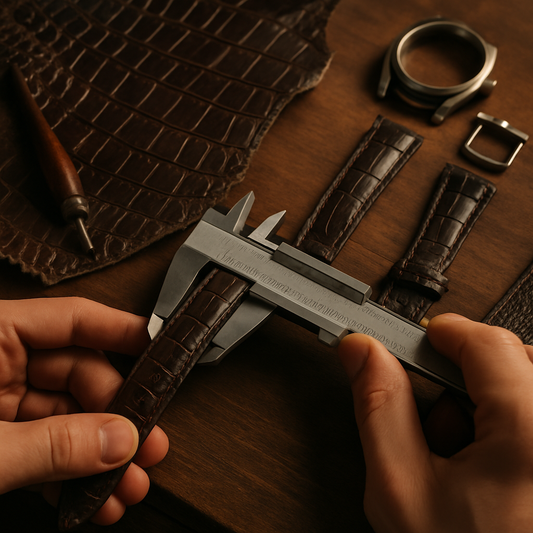
Watch-strap sizing starts with lug width, measured in millimetres between the watch lugs. Common examples include 18 mm, 20 mm, 21 mm, and 22 mm, but the correct size is the one specified by the watch case. A strap that is too narrow can move at the lugs; one that is too wide may not fit without forcing the leather.
Length should be selected from wrist circumference, not from watch size alone. Measure around the wrist where the watch is worn, then account for the case length, buckle or deployant clasp, and the preferred wearing position. A remote measurement can be as useful as an in-person try-on when it includes these details accurately. For a fitted result, provide the lug width, wrist circumference, watch reference if available, and whether the watch uses a standard buckle or folding clasp.
Thickness also deserves attention. A very thick strap can sit awkwardly under a close shirt cuff, while an overly thin strap may look undersized beneath a substantial steel or gold case. The watch’s original strap profile is a useful reference point, though a custom strap can be specified differently where the case design supports it.
What Determines the Price of a Crocodile Watch Band?
The price of a crocodile watch band reflects more than a general idea of quality. Species affects the hide’s appearance and availability. Hide grade matters because a strap requires a clean, defect-free cutting zone, and usable belly area determines how much suitable leather is available from a hide. Scale matching between the two strap halves can also increase material waste.
Construction adds further cost: strap dimensions, thickness, edge work, lining, buckle selection, compatibility with a deployant clasp, and handwork all affect the final specification. A made-to-measure strap may require more planning than a standard size because the cut must align with the requested width, taper, and scale presentation.
Grade labels need context. Grade I or Grade II hides are often sought for watch straps because visible flaws are difficult to conceal on a small strap surface. However, grading names and thresholds vary between tanneries and suppliers. A grade label is more useful when paired with clear photographs of the actual strap or a specific explanation of the visible cutting area.
Business Styling: Match by Setting
Office and daily professional wear
- Dark brown crocodile leather works naturally with brown, oxblood, or tan shoes and belts.
- Black straps suit black footwear, charcoal tailoring, navy suits, and restrained dial designs.
- Medium brown can work with navy, grey, beige, and business-casual clothing where black feels severe.
Client meetings and formal events
- A dark strap with a controlled sheen keeps the watch visually quiet beside a suit.
- Choose a taper that suits the case; a modest taper often keeps a dress watch from looking bulky.
- Coordinate the buckle metal with the watch case where practical, especially on simple dress watches.
Business-casual travel and presentations
- Brown, dark blue, or subdued grey-toned options can work with jackets, knitwear, and trousers.
- A more visibly varied crocodile pattern can suit a simple watch dial, provided the rest of the outfit is not equally pattern-heavy.
Care for a Crocodile Leather Watch Strap
Use a clean, dry cloth for routine dust removal. If a mark needs more than dry wiping, use a slightly damp cloth only as a last resort and keep moisture away from the strap’s edges, lining, and spring-bar area. Let the strap dry naturally away from direct heat and strong sunlight.
Remove the watch before swimming, showering, or activities that expose the strap to sustained moisture. Leather conditioning should respond to the strap’s condition, climate, and wear pattern rather than a fixed calendar schedule. Use a product appropriate for exotic leather only after testing it carefully on an inconspicuous area or obtaining advice from the maker.
Check Species Information and Trade Paperwork
Crocodilian watch straps are treated by CITES as small manufactured products. Cross-border purchases may require correct species documentation and permits where applicable, particularly because commercially used crocodilian leathers are commonly regulated. CITES documentation concerns lawful trade compliance; it should not be treated as proof of leather authenticity by itself.
Before ordering internationally, ask for the species name, country-of-origin information where available, and the paperwork needed for the destination. This is especially relevant for a custom order, since shipping rules can affect which materials can be sent to a particular country.
Choosing With a Clear Brief
For a business-focused crocodile watch band, provide the watch’s lug width, wrist measurement, buckle preference, desired strap length, and preferred colour family. Then focus on the visible leather: clean belly scales, a proportionate pattern, and construction suited to the watch’s case height and daily use. That brief gives the maker practical information to plan the cut rather than relying on a generic product description.
View CrocodileViet’s crocodile watch band collection to compare available strap styles and specifications. For sizing or a custom request, contact us through WhatsApp with your watch and wrist measurements.