
7 Things to Check Before You Buy Alligator Vs Crocodile Leather Online

Share
7 Things to Check Before Buying Alligator vs Crocodile Leather Online
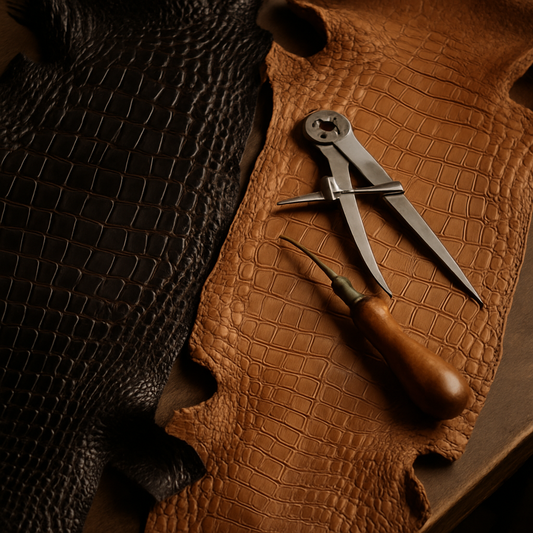
Alligator belly scales usually form a more regular, square-to-rectangular pattern, while crocodile belly scales tend to vary more in shape and often show small sensory pores called ISOs.
That visual difference is useful, but it is only the starting point for comparing alligator vs crocodile leather online. Product photos can hide the scale layout, crop out identifying features, or show a highly selected section rather than the actual item you will receive. Before ordering, check the species evidence, hide section, grade, measurements, construction, legal paperwork, and aftercare information.
1. Check whether the leather is actually alligator or crocodile
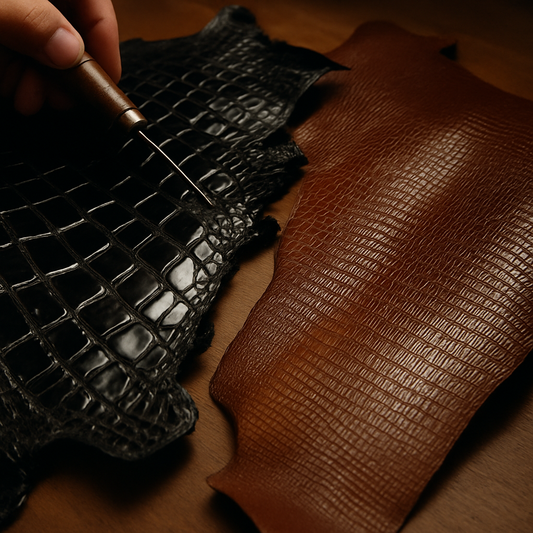
Ask the seller which species was used and request close photographs of the belly scales. Alligator belly skin commonly has a balanced arrangement of broad, squarer scales. Crocodile belly scales are often more varied and rounded, with small sensory pores visible as tiny dots on the scales. These pores are commonly called integumentary sensory organs, or ISOs.
Another useful clue is the umbilical scar. Alligator hides often show a small scar on the belly, while crocodile hides generally lack this feature. A product photograph may not show the scar if the maker has cut around it, so its absence in one image does not establish the species.
None of these visual details should be treated as a standalone certificate of origin. Ask for the species description on the product documentation, the source of the hide, and the relevant CITES documentation or tags where required. CITES paperwork relates to regulated international trade and legal movement; it does not, by itself, prove that a product is genuine or identify every detail of its construction.
| Point to compare | Alligator | Crocodile |
|---|---|---|
| Belly scale pattern | Usually more regular, broad, and square or rectangular | Often more varied, with rounder or less regular shapes |
| Visible sensory pores | Not usually present on the ventral belly scales | Often visible as small pores or dots |
| Umbilical scar | Often present | Generally absent |
| Main visual character | Balanced geometry and predictable scale spacing | Greater variation in scale shape and surface detail |
2. Check which part of the hide was used
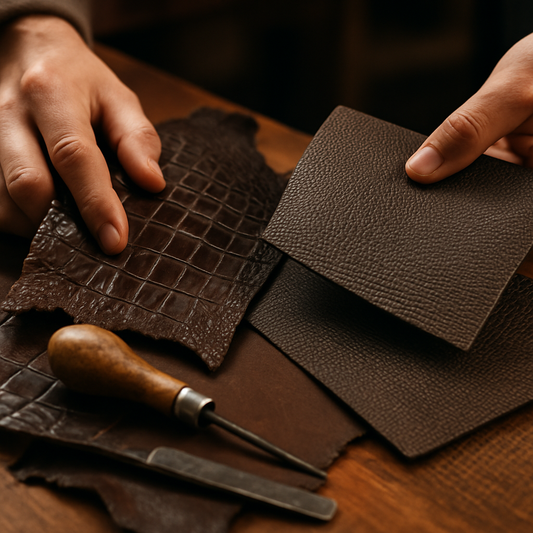
The hide section affects appearance, flexibility, scale layout, and price. Belly leather is generally the softest, most flexible, and most even-looking portion of an alligator or crocodile hide. It is commonly selected for wallets, handbags, watch straps, belts, and other goods where the surface is seen at close range.
A belly cut means the hide is opened along the belly so the smoother belly section can be used in the product. For our own workshop production, we use belly sections for items that benefit from flatter scales and controlled pattern placement. That helps a wallet sit more evenly in the hand and allows adjoining panels to be arranged with less visual disruption.
Hornback crocodile leather uses the dorsal back area, with the raised back scales left visible. It has a more rugged surface and a pronounced central ridge, so it should not be judged by the same visual standard as a smooth crocodile belly cut. Ask for a photograph of the entire cut, not only a close-up of one attractive panel.
Also ask whether the item uses one continuous belly panel, several joined pieces, side leather, or a combination of sections. A small accessory may contain a central belly panel with less prominent sections inside or on the reverse. That is not automatically a defect, but the construction should be described accurately.
3. Check the grade without treating it as a durability rating
Many suppliers describe exotic hides with grades from 1 to 5, with Grade 1 commonly indicating the fewest visible defects. Other suppliers use quadrant-based systems, counting defects according to the belly areas affected. Because grading labels vary by supplier and tannery, a number has meaning only when the seller explains its own system.
Ask these specific questions:
- Is the grade based on the belly or midsection rather than the complete hide?
- How does the seller define each grade?
- Are scars, scratches, healed marks, holes, wrinkles, or scale irregularities included in the assessment?
- Does the grade refer to the hide before cutting or to the finished product?
- Will the photographed item be the item shipped?
Visual grade mainly describes the number and placement of surface defects. It does not function as a direct durability score. A lower visual grade can still produce a serviceable product when the maker places the marked area away from stress points. Conversely, a high visual grade does not explain the thickness of the leather, the lining, the edge work, or the strength of the seams.
4. Check measurements in the way alligator and crocodile hides are actually sold
Alligator hides are commonly measured by belly width in centimeters at the widest point rather than by the square-foot method often used for other leather categories. Online listings may also give a size class, but that label is meaningful only if the seller states how the measurement was taken.
For a finished product, request measurements for the item itself:
- Wallet length, height, and closed thickness
- Handbag width, height, depth, handle drop, and strap range
- Belt length measured from the buckle to the usual fastening holes
- Watch-strap length for each half, including the buckle side
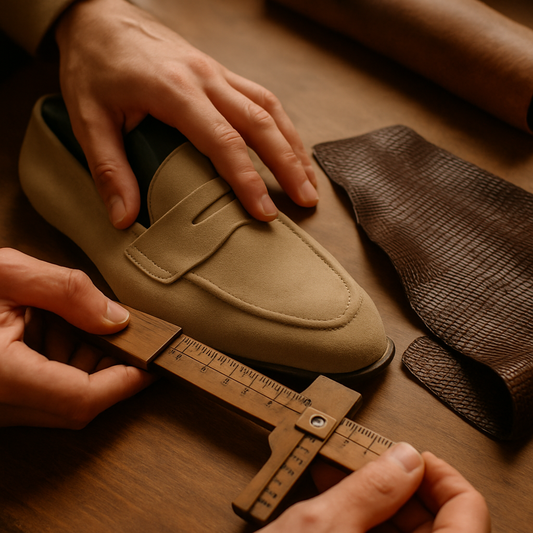
- Shoe insole length, width at the ball, opening circumference, and instep clearance
If the product is footwear, do not rely on an EU, US, or UK size alone. Request the maker’s conversion chart and compare it with a pair that fits you. Measure both feet while standing, record the longer foot, and report whether you need a wide fit or have a high instep. A remote measurement exchange should be treated as equally important as trying footwear in person, because the leather type does not remove the need to check internal dimensions.
5. Check the price by separating the real cost factors
There is no responsible single price for alligator or crocodile leather without knowing the species, hide section, grade, usable area, and finished design. Two products with similar dimensions can use very different amounts of selected belly leather or require different levels of handwork.
Ask the seller to explain the price through concrete factors:
- Species and documented source
- Belly, flank, tail, or hornback section
- Hide grade and the supplier’s grading method
- Usable area after trimming and defect avoidance
- Scale matching across front panels, gussets, flaps, or straps
- Leather thickness, lining, reinforcement, and hardware
- Construction method and the amount of handwork
- Complexity of edge finishing, folds, and internal compartments
Scale matching has a direct effect on material use. If a bag flap must align visually with a front panel, the maker may need to reserve a larger section of hide and discard more material during cutting. A product with a more varied pattern is not automatically lower grade, and a regular pattern is not automatically more durable.
6. Check the construction, not only the surface pattern
Online photographs often emphasize large belly scales because they attract attention, but the item will be used through its seams, folds, edges, lining, and attachment points. Request detailed photographs of the inside, corners, underside, strap anchors, zipper ends, and any area where the leather bends.
For a wallet, inspect whether the card slots are cleanly aligned and whether the leather has been skived or reduced appropriately at folded edges. For a bag, look at the base, handle attachments, shoulder-strap joins, and the transition between crocodile or alligator panels. For a belt, ask whether the leather is a single layer or mounted to another material, and where the buckle stress is carried.
At CrocodileViet, our in-house production approach lets us control the placement of belly panels during cutting and assembly. We do this to keep scale direction visually consistent and to place joins where they interfere less with the main pattern; it is not a claim that every product uses one unbroken hide section. Ask for the exact construction of the model you are considering.
7. Check legal documents, care instructions, and seller transparency
For international trade, ask what CITES documentation or tags accompany the product and whether the paperwork matches the declared species and item. Requirements can depend on the species, country of origin, destination, and product form. A seller who provides only a label such as “exotic leather” has not supplied enough information for a well-documented purchase.
Care instructions should also be specific to the finished item. Keep alligator and crocodile leather away from prolonged moisture, strong heat, solvents, and direct sun. Use a dry, soft cloth as the default cleaning method. If a mark requires more than dry wiping, use a barely damp cloth only as a last resort, test an inconspicuous area first, and dry the surface promptly without heat.
Do not apply conditioner on a fixed calendar schedule. The need depends on the finish, handling, climate, and the maker’s instructions. Ask whether the surface has a particular coating and which products the workshop permits. Store the item with room around it rather than pressing it against rough or sharply edged objects.
How to style the two leathers after buying
Alligator’s regular belly geometry works well when the item is intended to look orderly and coordinated. Practical combinations include:
- An alligator belt with plain trousers and a simple leather shoe
- An alligator wallet with a restrained watch strap in a related tone
- An alligator handbag with a solid-color suit, knitwear, or tailored outer layer
Crocodile’s more varied scale pattern can support a stronger texture contrast. Suitable pairings include:
- A crocodile cardholder with denim, brushed cotton, or a plain overshirt
- A hornback crocodile belt with workwear-inspired tailoring or dark trousers
- A crocodile bag with a simple coat or dress that leaves the leather texture visible
Matching every leather item to the same color is not required. Coordinate the formality, texture, and overall color temperature instead, and allow one crocodile or alligator piece to carry the visual focus.
Questions to send before placing an online order
- Which species is used, and can you show close images of the belly scales?
- Is the product made from belly, side, tail, or hornback leather?
- What grading system does the supplier use, and where are any visible marks?
- What are the finished measurements, including width, thickness, and strap or opening dimensions?
- Which parts are reinforced, lined, joined, or hand-finished?
- What CITES documentation or tags accompany the shipment where required?
- What dry-cleaning and conditioning instructions apply to this specific finish?
For more information about CrocodileViet’s leather work and product details, visit the CrocodileViet blog. You can also contact us through WhatsApp to request measurements, close-up photographs, species information, and construction details before ordering.