
How to Choose Crocodile Loafer Size Guide for Business Wear

Share
Crocodile Loafer Size Guide for Business Wear
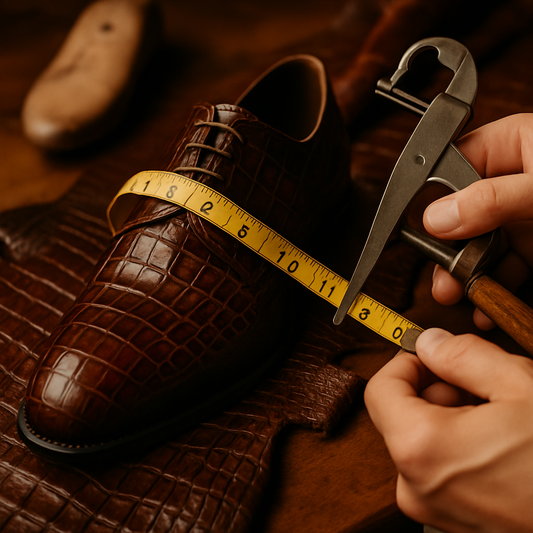
For crocodile loafers worn with business trousers, measure foot length, forefoot width, and instep while wearing the socks you plan to use. Compare those measurements with the maker’s last rather than relying only on a generic EU, US, or UK size.
What affects crocodile loafer sizing?
A loafer has no laces to compensate for a loose instep. Crocodile leather may also feel more structured and stretch less than soft textile footwear. The right size depends on the last shape, toe room, width, instep height, sock thickness, and how long you will wear the shoes during a business day.
Crocodile belly width is a trade measurement taken across the widest point of the belly area. It can help a workshop assess whether a hide will provide a controlled vamp layout, but it does not indicate whether the finished loafer will fit a wide foot.
Measure your feet before ordering
Measure at the end of the day, when your feet have reached their usual working size. Wear your business socks and measure both feet, since one may be longer or wider. Use the larger measurements when discussing the order.
- Length: measure from the back of the heel to the longest toe.
- Forefoot width: measure across the broadest part of each foot.
- Instep: measure the circumference over the highest part of the foot.
- Ball girth: measure around the broadest part of the forefoot.
- Heel width: record it if your heel commonly slips in loafers.
- Wear conditions: note sock thickness, standing time, walking, and any orthotics.
Also provide the brand, model, and size of footwear that currently fits, along with any specific problems. “Pressure across the little-toe joint” is more useful than simply saying that your feet are difficult to fit.
Length and toe room
Your longest toe should have room to move without touching the front during ordinary walking. Toe shape affects the internal space: a rounded or gently squared last can arrange the toes differently from a narrow pointed last, even when both shoes carry the same EU size.
Do not choose a longer loafer simply to gain width. Extra length can let the heel lift and may cause the foot to slide forward. A maker should assess the relationship between the toe box, ball position, and heel hold instead of solving a width problem with a larger size.
Size conversions vary between makers and lasts. Give your usual EU, US, or UK size as a reference, but include actual foot measurements before ordering.
Wide feet, high insteps, and heel security
A loafer that is long enough but narrow across the ball can create pressure. A loafer widened without accounting for the instep may allow the heel to lift. Mention the following before construction:
- Wide forefoot: identify the widest measurement and where pressure usually develops.
- High instep: report the instep circumference and whether slip-on shoes feel tight across the upper.
- Narrow heel: explain whether standard loafers slip at the back after a few steps.
- Different-sized feet: submit measurements for both feet rather than ordering from one foot alone.
- Orthotics or thick socks: state this in advance because the required internal volume may change.
When trying the loafers, walk, sit, and flex your feet rather than judging the fit while standing still. Business wear can involve stairs, meetings, and extended standing, so the shoes should remain secure without forcing the toes or compressing the instep.
In-person and remote fitting
An in-person fitting allows the maker to assess heel movement, toe clearance, pressure points, and how the upper sits over the instep. Bring the socks and, if relevant, the insole normally used during the working day.
For remote measurements, stand on paper with your full weight on the foot. Trace the outline without angling the pen inward, then record the length, width, instep circumference, ball girth, and heel width. Clear photographs beside a ruler may also help if requested. A maker may ask for additional measurements after reviewing the first set.
Crocodile leather layout and fit
When a workshop plans the visible vamp, belly-area cuts may be selected where the hide dimensions allow. Belly scale rows are often comparatively regular and balanced, which can support cleaner pattern control and pair matching. This is a visual and cutting consideration, not a substitute for choosing the correct width or last.
Crocodile pattern varies by species and by part of the hide. Visible sensory pores, sometimes called ISOs, may contribute to material identification when considered alongside species documentation, but no single visual trait proves authenticity. Alligator is a different material; its belly commonly shows a regular, balanced scale pattern and may have an umbilical scar that crocodile generally lacks.
Ask for the species to be identified on the relevant paperwork. CITES documentation concerns lawful international trade compliance; it is not, by itself, proof that a loafer is genuine. Species, hide grade, usable area, scale matching, construction, and handwork can all affect the price.
Business styling after the fit is confirmed
- Traditional office: pair dark brown or black loafers with navy, charcoal, or medium-grey trousers and a related leather belt.
- Client meetings: use a restrained scale layout with a navy suit, white or pale-blue shirt, and a solid or lightly patterned tie.
- Business casual: wear brown loafers with tailored chinos, wool trousers, an Oxford shirt, or an unpatterned knit jacket.
- Travel-heavy days: choose socks with suitable cushioning and trousers with a clean break that does not catch on the loafer.
Care that helps preserve the fit
Remove surface dust with a dry, soft cloth and let the loafers air away from direct heat. If dirt remains, use a barely damp cloth and dry the leather promptly. Avoid soaking the upper or applying untested products. Conditioning frequency depends on the product, climate, wear frequency, and leather finish, so ask the workshop before using an unfamiliar treatment.
Discuss your size with CrocodileViet
Send your length, width, instep, sock, and fit-history details to CrocodileViet for a sizing discussion before ordering. Include the business setting in which you plan to wear the loafers and any concerns about width, heel movement, or pressure.