
How to Choose Alligator Leather Jacket Men for Business Wear

Share
How to Choose a Men’s Alligator Leather Jacket for Business Wear
For business wear, a men’s alligator leather jacket is best selected with comparatively regular belly scales, a restrained silhouette, and enough room for the shirt or lightweight knitwear worn beneath it.
Genuine alligator leather gives a jacket a distinct surface: the belly area has a more regular, balanced scale pattern than many other crocodilian leathers. That visual order matters in professional settings, where the jacket should read as intentional rather than visually busy. The goal is not to hide the alligator scales, but to place and proportion them so they support a clean business wardrobe.
Start With Genuine Alligator Leather, Not an Embossed Print
An alligator leather jacket for men should be made from genuine alligator hide rather than embossed cowhide or a generic exotic-print material. Embossed leather can imitate a scale motif, but it does not have the separate natural scale structure, variation in scale size, or character of actual alligator leather.
Alligator belly leather is particularly relevant for business jackets because its scales are comparatively regular and visually balanced. In contrast, crocodile leather varies more by species and often shows visible sensory pores, also called ISOs, on the belly scales. An alligator hide may also show an umbilical scar, while crocodile leather typically does not show this feature. These characteristics are useful context, but one visual trait alone does not establish authenticity.
The term “genuine crocodile jacket” is sometimes used loosely in retail descriptions, but it describes a different material category from an alligator jacket. If a seller uses broad wording such as “exotic leather jacket,” ask for the exact species and confirmation that the leather is genuine hide rather than an embossed alternative.
Why Belly Panels Suit a Business Jacket
The belly is the most sought-after area of an alligator hide for fashion leather because it offers the most regular scale formation. For a business jacket, this section is especially useful on the front panels, where the eye naturally focuses first.
At CrocodileViet, the panel layout should be reviewed before construction because scale placement affects the jacket’s visual balance. A centered or well-matched belly layout helps the front read cleanly when the jacket is worn open over a shirt, while flatter scales reduce unnecessary bulk across the chest and waist.
Not every part of a hide serves the same purpose. A hide has finite usable belly area, and large jacket panels require more of it than small accessories. This is one reason a jacket with well-positioned belly leather can carry a substantially different price from an item using smaller or less visually consistent panels.
Choose a Business-Appropriate Jacket Shape
Alligator leather already has surface presence, so the most adaptable business designs tend to use controlled lines rather than excess hardware or oversized decorative features. A jacket can still have personality through its scale layout, color depth, and cut without relying on large logos, heavy quilting, or numerous external pockets.
Useful Styles for Office and Client Settings
- Minimal zip-front jacket: Suitable for business-casual offices, client lunches, and travel days. A clean front lets the scale pattern remain the main visual feature.
- Leather overshirt or shirt-jacket: Works with trousers and knitwear in workplaces where a blazer is not required. Check that the shoulders sit cleanly without pulling across the upper back.
- Structured collar jacket: A practical option for meetings outside the office, particularly with a collared shirt. Keep pocket and zipper detailing limited for a more composed result.
- Short tailored jacket: Can work in creative and executive business-casual environments when the hem sits neatly around the hip and does not bunch while seated.
A highly cropped biker cut, a heavily belted style, or a jacket with extensive metal hardware may suit personal occasions, but those details can compete with the regular pattern of alligator belly leather in conservative workplaces.
Evaluate the Hide Grade Without Treating It as a Universal Label
For American alligator hides, grading commonly focuses on defects in the belly area rather than the full hide. Some suppliers use a Grade 1 through Grade 5 scale, where Grade 1 generally refers to a belly area without visible defects and lower grades reflect more or more significant scars, scratches, shading, or scale deformities.
Those labels are not universal. Grade names and thresholds can vary by tannery or supplier, so a number alone does not explain the appearance of a finished jacket. Ask where the more visible panels are placed and whether scars, shading changes, or irregular scales appear on the front, sleeves, collar, or less conspicuous sections.
Visual grade should also be separated from durability. A hide with a cleaner-looking belly pattern may command a higher price because it provides a more controlled appearance across large panels. It does not automatically mean that another properly made alligator leather jacket is structurally weak.
| Decision factor | What to inspect in a business jacket | Why it affects the result |
|---|---|---|
| Species confirmation | Clear identification of genuine alligator hide | Confirms that the jacket has the scale structure and material value being represented. |
| Belly-panel layout | Regular scale flow across the chest and front opening | Creates a more orderly appearance for workwear. |
| Hide grade and marks | Location of scars, scratches, shading, and scale irregularities | Determines how visually clean the most prominent panels appear. |
| Construction | Seam placement, panel matching, collar shape, lining, and closure alignment | Determines how the jacket hangs, closes, and wears in daily use. |
| Fit allowance | Chest, shoulder, sleeve, and waist room over work clothing | Helps prevent strain across leather panels during sitting and movement. |
Understand What Drives the Price
There is no single meaningful price for a men’s alligator leather jacket because the cost depends on the material and the work required to turn irregular natural hides into a wearable garment.
- Species: Genuine alligator hide is a specific material, not simply a printed pattern.
- Hide grade: Cleaner belly areas with fewer visible defects are more limited and can affect cost.
- Usable area: A jacket consumes far more leather than a small item, especially when broad front panels are made from belly sections.
- Scale matching: Aligning panels so scale size and direction read consistently requires planning and may reduce usable yield from each hide.
- Construction: The number of panels, seam design, closures, collar structure, lining work, and pocket construction all influence labor.
- Handwork: Cutting, fitting, panel arrangement, and finishing work become more demanding when natural scale patterns must be positioned with intention.
A lower price can reflect a smaller usable belly area, more visible marks, a different leather material, simpler construction, or a less controlled panel layout. It is worth comparing material descriptions and construction details rather than relying on a broad quality claim.
Get the Fit Right Before Focusing on Styling
Fit is particularly important with alligator leather because a jacket that pulls tightly can place stress on seams and create awkward horizontal tension across the scale pattern. Business wear also requires enough mobility for driving, sitting through meetings, reaching for a bag, and wearing a shirt or knit layer underneath.
In-person try-on is valuable, but remote measurements are equally important for a made-to-order or distance purchase. Measure a jacket that already fits the intended use rather than measuring the body alone. Compare its chest width, shoulder width, back length, sleeve length, and hem width with the proposed garment measurements.
- Chest: Leave practical ease for the layers you wear to work. A jacket intended only for a thin shirt needs different room from one intended for a fine-gauge sweater.
- Shoulders: The shoulder seam should sit close to the natural shoulder edge without restricting arm movement.
- Length: For business use, a hem around the hip is often easier to pair with tailored trousers than an aggressively short cut.
- Sleeves: Check sleeve length with arms relaxed and while reaching forward. Excessive tightness at the elbow can become apparent during a full workday.
- Waist and hem: Confirm that the jacket closes without pulling when seated.
EU, US, and UK size labels are useful starting points, but the numbers are not interchangeable across brands. Prioritize actual garment measurements. For a wide fit, broad shoulders, fuller chest, or a prominent instep concern in the case of footwear-related outfit planning, measurements provide more reliable information than a general size label; for jackets specifically, shoulder and chest measurements should lead the decision.
Style an Alligator Jacket Within a Business Wardrobe
Business-Casual Office
- Dark alligator jacket, pale blue or white shirt, charcoal wool trousers, and restrained leather shoes.
- Brown-toned alligator jacket, fine-gauge navy knitwear, stone or tobacco trousers, and a simple belt.
- Black alligator jacket, black or grey crew-neck knitwear, dark tailored trousers, and minimal accessories.
Client Lunches and Evening Meetings
- Structured alligator jacket over a collared shirt with dark trousers and a clean watch.
- A darker jacket with a black turtleneck and tailored trousers for a contemporary business setting.
- A brown jacket with an off-white shirt and deep navy trousers for a softer contrast.
Business Travel
- Zip-front jacket, wrinkle-conscious shirt or knitwear, dark trousers, and a compact leather bag.
- Alligator overshirt worn open over a plain knit top and tailored travel trousers.
Match by visual weight rather than trying to match every leather item exactly. A jacket with pronounced scales can sit well beside smooth leather shoes or a restrained belt, while another heavily patterned leather item may create too much competing texture.
Care for an Alligator Leather Jacket
Use a soft dry cloth for routine dust removal. If a mark requires more than dry wiping, use a slightly damp cloth only as a last resort, apply minimal moisture, and allow the leather to dry naturally away from direct heat and strong sunlight.
Avoid soaking the jacket, household cleaners, alcohol-based wipes, perfume overspray, and untested oils. Leather conditioners should be selected cautiously and used only when the leather’s condition calls for it; conditioning needs depend on wear, climate, finish, and storage conditions rather than a fixed calendar schedule.
Store the jacket on a broad, supportive hanger so the shoulders retain their shape. Keep it in a cool, dry space with air circulation, and avoid prolonged compression under heavy garments. If the jacket receives a deep stain, water exposure, or seam damage, professional assessment is safer than aggressive home treatment.
Ask About Legal Sourcing Documentation
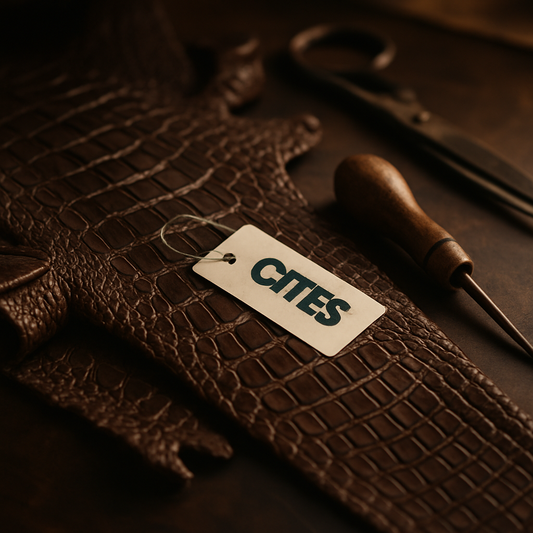
American alligator trade is controlled under CITES Appendix II because the species can be confused with more threatened crocodilian species. CITES documentation relates to lawful trade compliance; it does not by itself prove that a particular jacket is authentic alligator leather.
For cross-border purchases or sourcing questions, ask about origin documentation and the permits required by the exporting and importing countries. Requirements can differ by destination, so the relevant paperwork should be checked for the specific transaction.
Choose With the Finished Business Wardrobe in Mind
The strongest men’s alligator leather jacket for work is one whose material, panel layout, fit, and construction suit the clothing already in regular rotation. A controlled belly-scale layout, a clean silhouette, verified material description, and measured fit offer more useful criteria than a broad luxury label.
View CrocodileViet’s alligator and crocodile jacket collection to compare available directions. For sizing, hide details, or cross-border order questions, contact CrocodileViet through WhatsApp.