
Best Custom Crocodile Belt for Men: What to Look For

Share
How to Choose the Best Custom Crocodile Belt for Men
A well-chosen custom crocodile belt for men starts with verified crocodile species, belly-cut leather, accurate sizing, and a buckle suited to the wearer’s daily use.
Start by Identifying the Crocodile Species
“Crocodile belt” should describe the actual animal used for the leather. Common examples include saltwater crocodile (Crocodylus porosus) and Nile crocodile (Crocodylus niloticus). American alligator (Alligator mississippiensis) is a different species, so an alligator belt should be identified as alligator rather than crocodile.
Species matters because scale structure, available cutting areas, sourcing paperwork, and the final appearance can differ. A product description should state the species or provide clear sourcing information instead of relying only on terms such as “exotic leather.”
Choose Belly Leather for a Regular Strap Surface
For a conventional men’s belt, belly leather is usually the practical starting point. The belly presents a relatively smooth surface with regular, balanced scale rows that sit comfortably against clothing and create a controlled pattern along the strap.
Crocodile scale patterns vary more by species and individual hide than many buyers expect. Visible sensory pores, often called integumentary sensory organs or ISOs, may appear as small dots in the scales. Their presence can be a useful visual clue, but scale appearance or a single sensory feature cannot prove authenticity by itself.
Alligator belly leather commonly has an umbilical scar, while crocodile leather lacks this characteristic feature. The transition from belly scales to flank scales can also help distinguish the two: alligator belly scales tend to change more abruptly, while crocodile scales generally transition more gradually. These are identification clues, not substitutes for species information and sourcing documentation.
Know the Difference Between Belly Cut and Hornback
A belly-cut strap has the flatter, orderly appearance most men associate with a dress or business belt. A hornback belt is cut to show the raised dorsal scutes along the animal’s back. Its surface is more textured and pronounced, so it communicates a different design direction.
Neither cut is automatically better. Belly leather suits tailored trousers, office clothing, and understated outfits. Hornback can work with denim, boots, or casual garments where the raised structure is intended to be visible. The important point is to confirm which hide section the maker will use rather than assuming that every crocodile belt has the same scale layout.
Ask What the Leather Grade Actually Means
Grade labels are not standardized across the leather industry. One supplier may use letters, another may use numbers, and a workshop may define its grades according to the amount of usable, relatively blemish-free cutting area. Scars, holes, scale damage, and other defects can affect that usable area.
A higher grade does not provide a universal guarantee of belt quality. Ask three specific questions:
- What does the maker’s grade or classification mean?
- Will the visible strap section be cut from the belly area?
- Will natural marks or scars appear on the finished belt?
A belt can still be well made with a small natural mark. The relevant issue is whether the maker explains where that mark will appear and how it affects the visible strap.
Check Strap Construction and Buckle Details
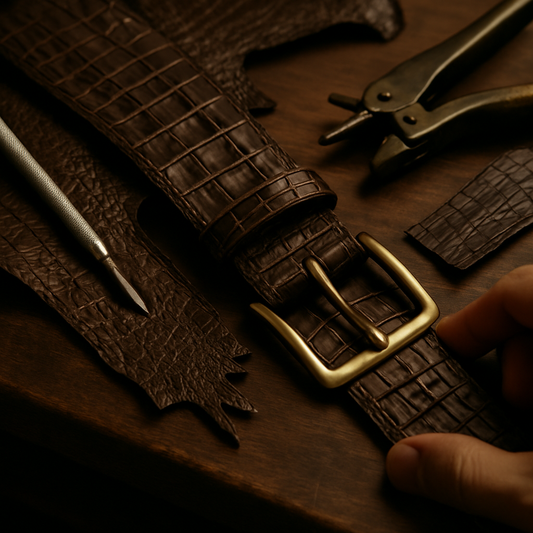
Custom work should define more than the leather type. Confirm the finished strap width, edge treatment, color, lining, stitching, belt loops, and buckle finish before production begins. A narrow strap can sit more neatly with formal trousers, while a wider strap may work better with denim or casual clothing. The buckle should also match the wearer’s wardrobe: polished metal has a sharper appearance, while brushed or darker finishes are easier to combine with relaxed clothing.
Ask how the buckle attaches and whether it can be replaced later. A removable buckle gives the wearer more flexibility if the belt will be used with both office and casual outfits. The visible crocodile pattern should also be discussed in advance, especially if the customer wants the scales centered along the strap rather than arranged asymmetrically.
Get the Fit From Measurements, Not Guesswork
Belt sizing should be based on the wearer’s usual fastening position, not simply trouser size. Measure from the buckle’s fastening point to the hole used most often, then provide the desired total length and strap width to the workshop. A useful custom order should record both the length and width because two belts with the same length can wear differently if their buckle and hole placement differ.
- Length: provide the preferred measurement from buckle attachment to the usual hole, plus the total strap length if available.
- Width: check that the strap fits the belt loops on the trousers or jeans worn most often.
- International sizing: EU, US, and UK trouser sizes do not convert perfectly across brands, so a physical measurement is more reliable than a size label.
- Wide fit: wider waist measurements may require extra strap length and a suitable buckle position rather than simply adding one standard size.
- Remote orders: send a measurement of a current belt that fits well, measured from the buckle pin to the frequently used hole.
The wearer’s body shape can also affect the best hole position. A higher instep is relevant to footwear rather than belt sizing, but it becomes important when coordinating a crocodile belt with custom shoes. Customers ordering How to Choose Bespoke Crocodile Leather Shoes for Business Wear may want the belt width, leather tone, and buckle finish to relate to the shoes without requiring an identical texture.
Understand the Price of a Custom Crocodile Belt
Price depends on concrete specifications rather than the word “custom” alone. The main factors include the crocodile species, the usable size and grade of the hide, the length and width of the strap, the amount of visible belly area, lining material, buckle type, edge finishing, stitching, and the complexity of the requested pattern.
A larger waist measurement can require a longer strap and more usable hide. A wide strap can also use more leather than a narrow dress belt. A special buckle, contrasting lining, hand-finished edges, or centered scale arrangement may add labor or material cost. Ask for a written specification so the quoted price can be compared with the actual belt being made.
Review Sourcing and Cross-Border Paperwork
CITES treats belts as small manufactured crocodilian-leather products, and trade in crocodilian goods can require permits or certificates. Requirements depend on the species, source, destination, and applicable exemptions.
A buyer arranging an international purchase should verify the paperwork requirements with the relevant authorities for that specific transaction. A seller’s description, a leather pattern, or a CITES reference should not be treated as a standalone guarantee that a belt can enter or leave a country without additional documentation.
Care for the Finished Belt
After wearing, wipe the belt with a dry, soft cloth to remove surface dust and perspiration. Store it flat or loosely rolled with the leather side protected from sharp pressure. Keep it away from prolonged moisture, high heat, direct sunlight, and solvents.
There is no useful fixed schedule for conditioning every crocodile belt. The need depends on the climate, frequency of wear, and finish applied to the leather. If the surface becomes dry or dull, ask the workshop which product is suitable before applying a general leather cream. Avoid soaking the belt, and allow accidental moisture to dry naturally rather than using a heater.
Style the Belt With the Rest of the Wardrobe
For business clothing, a belly-cut strap with a restrained buckle usually coordinates well with tailored trousers, loafers, or bespoke crocodile leather shoes. The belt does not need to match the shoes exactly; a related depth of color and similar metal finish can create a connected outfit.
With denim or chinos, a wider strap or hornback cut can make sense because the clothing can support a stronger texture. A dark belt works with navy, charcoal, and brown tailoring, while lighter brown can connect with tan footwear and casual jackets. If the belt will be worn with an alligator watch strap, keeping the colors related while varying the scale pattern prevents the accessories from appearing mechanically identical.
Frequently Asked Questions
What should a custom crocodile belt be made from?
For a conventional men’s belt, crocodile belly leather is usually suitable because it has a relatively smooth surface and regular, balanced scale rows. Confirm the actual crocodile species and whether the visible strap is cut from the belly area.
How can I tell whether a belt is crocodile or alligator?
Scale patterns, sensory pores, scale transitions, and the presence or absence of an umbilical scar can provide clues. Alligator belly leather commonly has an umbilical scar, while crocodile leather lacks it. Species and sourcing documentation provide stronger identification than one visual feature.
Is a higher crocodile leather grade always better for a belt?
Not necessarily. Grading systems vary by supplier and commonly reflect usable, relatively blemish-free cutting area. Ask what the grade means and inspect the planned visible strap section rather than relying on the grade label alone.
Can I order a crocodile belt internationally without a permit?
Paperwork depends on the species, source, destination, and applicable exemptions. Verify the requirements for the specific transaction with the relevant authorities before assuming that a permit or certificate is unnecessary.
For a custom crocodile belt specification, contact CrocodileViet with your preferred length, width, buckle, color, and measurement details. WhatsApp is also available for discussing remote measurements and design requirements.