
Best Genuine Crocodile Belt for Men: What to Look For

Share
Best Genuine Crocodile Belt for Men: What to Look For
A genuine crocodile belt for men should usually be judged first by its documented crocodilian source, usable belly area, scale layout, and construction—not by the word “genuine” alone.
What “genuine crocodile” should mean
“Crocodile leather” and “alligator leather” describe different animals and should not be used interchangeably. A seller offering a genuine crocodile belt should identify the species where available, such as saltwater crocodile or Nile crocodile, because species can affect scale pattern, texture, origin, and the paperwork connected with the hide.
Visual inspection can help you understand a belt, but one sensory feature cannot prove authenticity. Crocodile skin often shows visible sensory pores, sometimes called ISOs, and the pattern may vary across the belly. Those details are useful observations rather than a stand-alone certificate of origin.
Legal documentation matters because crocodilian skins are regulated wildlife products. CITES-related permits or certificates concern international trade compliance; they do not, by themselves, prove that a particular belt is genuine. Ask the seller how the product’s species and sourcing documents correspond with the finished belt and the destination country’s requirements.
Start with the leather section: belly, flank, or hornback
For a dress-oriented crocodile leather belt, the central belly is commonly preferred because it is smoother and more pliable than flank or hornback material. The belly also provides the regular, flatter scale arrangement most people associate with a formal crocodile belt.
Hornback is different. It comes from the animal’s back and retains raised bony scutes, producing a rugged, heavily textured surface. That appearance can suit casual or western styling, but it should not be confused with smooth belly leather. Flank leather has its own texture and may be used in belt designs where a less regular surface is intentional.
At our workshop, we assess the usable belly area before planning the belt because the central cutting zone controls both the visible pattern and how much defect-free leather can be used. A large belly hide does not automatically produce a high-grade belt: scars, holes, wrinkles, and parasite marks can reduce the workable area and affect how the pattern must be positioned.
How to assess the scale pattern
Crocodile belly scales are generally less regular than alligator belly scales and may appear rounder or more varied, depending on the species and the location on the hide. That variation is part of crocodile leather’s character, but excessive interruption across the main visible section can indicate a difficult cutting area or a deliberate lower-grade presentation.
Inspect the belt from the buckle end to the tip. On a well-planned genuine crocodile belt, the central scales should form a visually controlled line rather than changing abruptly in size or direction. The scales do not need to look mechanically identical. Instead, look for a pattern that suits the belt’s length and width, with the most visible area positioned attractively.
Scale matching becomes especially important on belts made from multiple leather sections. The maker may align neighboring pieces by scale size, direction, and color so that the joins do not distract from the belly pattern. Exact matching can reduce usable yield, which is one reason a carefully planned belt may cost more than one assembled with less pattern control.
| Decision factor | What to inspect on a genuine crocodile belt | Why it affects the result |
|---|---|---|
| Species identification | The named crocodile species and corresponding sourcing information | Species can influence scale shape, texture, origin, and compliance paperwork |
| Usable belly area | The central section available after excluding scars, holes, wrinkles, or parasite marks | It affects grade, yield, placement, and the amount of visible defect-free leather |
| Scale layout | Regular visual flow, sensible scale size for the belt width, and controlled joins | It determines how balanced the finished belt looks when worn |
| Construction | Edge finishing, buckle attachment, lining, keeper loops, and stitch consistency | These parts influence fit, comfort, repairability, and day-to-day performance |
| Documentation | Species details and legally relevant sourcing or trade records where required | Crocodilian leather is regulated in international trade, so vague sourcing claims are insufficient |
Grade is about usable leather, not guaranteed durability
In crocodile belt production, visual grade commonly reflects how much of the central belly is free from visible defects and how efficiently that area can be cut. A higher grade may offer a broader, cleaner presentation across the belt, while a lower grade can still be suitable for a darker finish, a more textured design, or a layout that places natural marks away from the most visible zones.
Visual grade should not be treated as a direct measure of durability. A belt’s working life also depends on its thickness, reinforcement, lining, buckle attachment, edge treatment, stitching, bending, moisture exposure, and how tightly it is pulled. A visually clean hide can be poorly constructed, while a belt with a small natural mark can have sound construction.
Grading names also vary by supplier and tannery. Terms such as “top grade” or letter grades do not have one universal meaning across the trade. Ask what the label refers to: defect frequency, central belly coverage, scale size, color consistency, or the amount of leather usable for the specific belt.
Construction details worth checking
Leather thickness and lining
A belt needs enough structure to support trousers without becoming stiff at the waist. Ask whether the crocodile leather is used as a surface layer over a supporting leather core or forms part of a different construction. The answer affects flexibility, edge appearance, repair options, and how the belt should be worn.
Edges and stitching
Check that the long edges feel smooth rather than sharp or excessively painted. At the buckle end, inspect the fold or attachment area for clean alignment and secure stitching. Keeper loops should hold the belt tail without crushing the leather. If the belt is stitched, consistent spacing and a straight stitch line are useful signs of controlled assembly.
In our belt work, construction choices are made around the crocodile surface rather than treating it like ordinary cowhide. The reason is practical: large belly scales can be visually disrupted by an awkward seam, a poorly placed hole, or an edge that cuts across the pattern without a plan.
Price: what you are actually paying for
The price of a genuine crocodile belt is shaped by several concrete inputs:
- Species: Different crocodile species can differ in scale characteristics, hide availability, source, and documentation requirements.
- Hide grade: A broad, low-defect central belly area generally gives the maker more usable cutting material.
- Usable area: A large hide may produce limited belt material if defects or irregular sections reduce the practical yield.
- Scale matching: Planning the visible scales and aligning sections can require more material and labor.
- Construction: Lining, reinforcement, buckle hardware, edge finishing, and replaceable components affect the finished cost.
- Handwork: Cutting around natural features, setting the buckle, making holes, finishing edges, and stitching each add labor.
A higher price should therefore come with an explanation of the species, belly section, construction, and workmanship. It should not rest only on a vague grade label or a claim that the belt is “exotic.” We do not assign a price from the word crocodile alone; the hide yield and the intended construction must be assessed together.
Fit and sizing: measure the wearer, not just the belt
Belt sizing is not standardized in the same way across EU, US, and UK clothing systems. A listed belt size may refer to the distance from the buckle pin to the center hole, the wearer’s waist, or the total leather length. Confirm the seller’s measurement method before ordering.
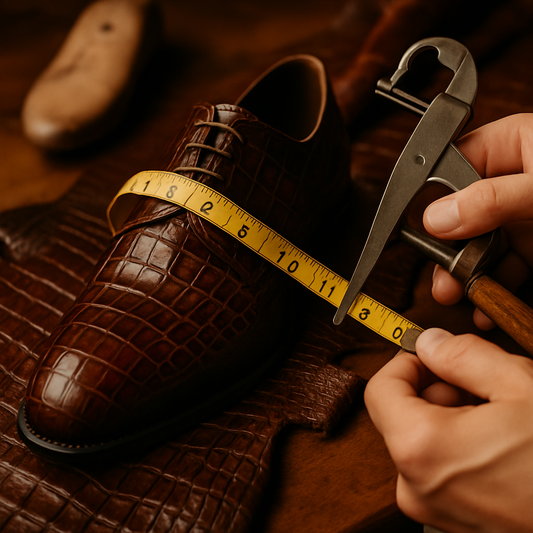
For an in-person fitting, wear the trousers that will be used with the belt and measure from the buckle position to the hole that gives a comfortable hold. The center hole is usually the most useful reference, leaving room to tighten or loosen the belt. Also check the belt width against the trouser loops: a wide belt may not pass through narrow loops, while a narrow belt can shift inside wide loops.
Remote measurement should receive the same care as an in-person try-on. Measure an existing belt from the point where the buckle pin bends around the leather to the hole you use most often. Do not measure only the total end-to-end length unless the seller specifically requests it. Send the waist measurement, preferred hole position, belt width, and buckle style together.
EU, US, and UK trouser labels can differ between brands, so a nominal waist number is only a starting point. Wide-fit trousers may need a different hole position from slim trousers even for the same wearer. An instep measurement has no role in belt sizing; it belongs to footwear fitting. If a seller requests an instep measurement for a belt, clarify what product specification they are actually calculating.
Care for a crocodile leather belt
After wearing the belt, wipe it with a clean, dry cloth to remove surface dust and perspiration. Keep it away from prolonged heat, direct sunlight, and damp storage. Hang or store it flat without sharply folding the leather, and avoid leaving it tightly rolled around a small object.
If a mark needs more than dry wiping, use a barely damp cloth as a last resort and test an inconspicuous area first. Do not soak the belt or apply household cleaners. Conditioning should depend on the leather’s surface, climate, use, and the product maker’s instructions rather than a fixed calendar schedule. Too much product can soften the structure, darken the finish, or collect in the spaces around the scales.
If the belt becomes wet, blot it gently and let it dry at room temperature. A hairdryer, radiator, or strong sunlight can dry the leather unevenly and increase the risk of stiffness or surface change.
How to style a genuine crocodile belt
- Business clothing: Use a narrower, smooth-belly belt with tailored trousers, a plain shirt, and leather dress shoes in a related color family. Keep the buckle restrained if the belt is strongly patterned.
- Formal events: A dark crocodile leather belt with a low-profile buckle works with a suit when the width fits the trouser loops. Coordinate the belt with the shoes without requiring an exact color match.
- Smart-casual clothing: A medium-width belt can work with chinos, an Oxford shirt, or a textured jacket. Brown, deep burgundy, and black finishes create different levels of contrast against neutral trousers.
- Casual or western clothing: Hornback or a more visibly textured crocodile surface can suit denim and boots, provided the buckle and belt width fit the rest of the outfit.
The belt’s scale size, finish, width, and buckle should be considered together. A highly visible belly pattern may need simpler clothing around it, while a darker, smaller-scale belt can sit more quietly with patterned trousers or a textured jacket.
Questions to ask before ordering
Is a crocodile belt the same as an alligator leather belt for men?
No. They come from different species. Alligator belly leather is often more regular and square or rectangular in its scale pattern, while crocodile belly leather generally varies more and may show visible sensory pores. The choice should be based on the named material, appearance, documentation, and construction rather than treating the two terms as interchangeable.
Does a clean-looking surface prove the belt is crocodile?
No single visual or tactile feature proves species. Ask for the species description and legally relevant sourcing information. A clean surface may indicate a well-selected cutting area, but it does not replace documentation.
Can natural marks appear on a genuine crocodile belt?
Yes. Natural skin can contain marks, and their position and extent affect grade and cutting yield. The important question is whether the seller describes them accurately and whether they compromise the belt’s structure or simply form part of the visible surface.
What should I do if the belt does not fit after remote ordering?
Check the seller’s alteration and return terms before purchase. Crocodile leather is not safely adjusted by guessing at a new buckle position, because an incorrectly placed hole can cut through an unattractive scale area or weaken the belt end. Provide measurements from a belt you already wear when requesting a custom size.
To compare available genuine crocodile belt designs from CrocodileViet, visit our crocodile belt collection. You can also contact us through WhatsApp with your waist measurement, preferred width, buckle preference, and intended use.