
Australian Crocodile Leather and Conservation: What Luxury Buyers Should Know

Share
Australian Crocodile Leather and Conservation: What Luxury Buyers Should Know
Australian crocodile leather generally refers to leather from the saltwater crocodile, Crocodylus porosus, rather than from Australia’s separate freshwater crocodile trade.
What “Australian crocodile leather” usually means
In the leather market, the Australian description normally points to saltwater crocodile leather sourced through Australia’s regulated crocodile-management system. Australian freshwater crocodile leather is a separate category, and its commercial trade is now considered unviable.
The word “Australian” should describe more than a marketing color or a seller’s location. Buyers should ask whether it refers to the species, the place where the crocodile was raised or harvested, the tannery, or the finished product’s country of manufacture. These details can describe different stages of sourcing.
Australian saltwater crocodiles are listed in CITES Appendix II. This permits regulated international trade under applicable controls; it does not mean that trade is unrestricted. Export permits, import requirements, and destination-country rules can still apply.
How crocodile conservation is connected to leather sourcing
Australia manages its crocodile trade through permits and approved management plans. A substantial part of the Northern Territory’s wild-harvest system involves collecting eggs for captive rearing. CITES-related sources report that Northern Territory crocodile populations increased under this managed-use program.
This model connects conservation with controlled commercial value. When management authorities set collection limits, monitor populations, and require documentation, crocodile farming and regulated harvest can operate within a wider wildlife-management framework. That does not make every product automatically traceable or compliant, however. The responsibility still extends through the seller, exporter, importer, and final retailer.
For a luxury buyer, crocodile leather conservation is therefore not proved by the word “Australian” alone. Ask for product-specific or supplier-specific information covering the species, source, relevant permits or trade documents, and the chain between the hide and finished item.
What paperwork can and cannot establish
CITES documentation supports legal trade, but it is not, by itself, proof of a particular item’s species, geographic origin, or leather quality. A document may relate to a shipment or regulated source without describing every finished wallet, belt, bag, or pair of shoes in detail.
At CrocodileViet, we treat traceability information and physical leather assessment as separate checks because paperwork addresses legal sourcing while the hide itself determines scale layout, usable area, scars, and finishing. We recommend that buyers compare the seller’s description with the actual product and ask for clarification where the two do not match.
| Buying factor | What to ask | Why it matters |
|---|---|---|
| Species | Is the leather from Crocodylus porosus or another crocodilian? | “Crocodile” and “alligator” describe different animals with different scale characteristics. |
| Origin | Does “Australian” describe the animal, the hide, the tannery, or the finished item? | These stages can occur in different countries. |
| Documentation | What product-specific traceability or trade paperwork is available? | CITES-related paperwork supports regulated trade but does not independently prove species or quality. |
| Hide description | Which part of the hide was used, and how does the supplier define its grade? | Grading labels vary among tanneries and sellers, so a label needs a written definition. |
Reading the leather without overclaiming authenticity
A belly cut describes leather taken from the underside of a hide. It is not a species, origin, or universal grade. The usable area depends on scars, blemishes, scale layout, finishing, and the way the hide was cut.
Alligator belly leather often shows a regular or balanced scale pattern, and an umbilical scar may be visible. Crocodile leather tends to vary more by species and individual hide, and sensory-pit markings, sometimes called integumentary sensory organs or ISOs, may be visible in some areas. These features can help with assessment, but scale appearance or one sensory trait does not prove Australian origin or authenticity by itself.
Alligator and crocodile leather can both be genuine while showing different surface patterns. For a broader discussion of identifying alligator leather, see How to Choose How To Spot Real Alligator Leather for Business Wear.
Visual grade is also separate from durability. A more regular pattern may affect appearance and cutting efficiency, while durability depends on the leather’s structure, tanning, thickness, finishing, construction, and how the finished item is used. A supplier’s A/B/C or numbered label should therefore be treated as that supplier’s system, not a universal industry scale.
Price factors for Australian crocodile leather goods
There is no responsible single price for an Australian crocodile leather product without examining the item and its specification. Concrete price factors include:
- the amount of crocodile leather used and whether the panels come from the belly, flank, tail, or another section;
- scale size, regularity, and the amount of usable surface after scars or blemishes are excluded;
- the tanning and finishing method, including the final hand feel, sheen, and color consistency;
- pattern placement and the number of crocodile panels required for the design;
- lining, hardware, edge construction, stitching, and other non-crocodile components;
- labor involved in cutting, assembling, and finishing the product;
- traceability, export, import, and compliance requirements connected with the supply chain.
A higher price can reflect more leather, more complex construction, or stronger documentation, but price alone does not establish legal origin or leather quality.
Fit and sizing for crocodile leather goods
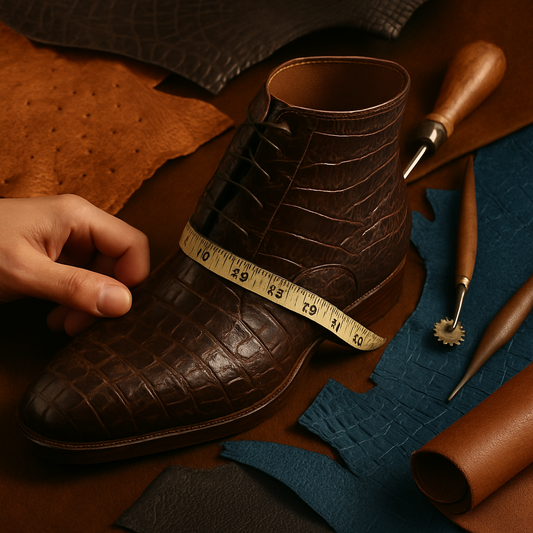
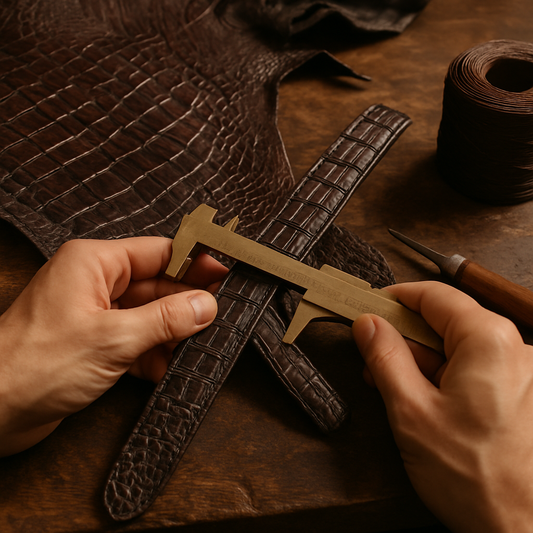
For belts, ask for the actual length from the buckle fold to the most-used middle hole, not only the total strap length. For shoes, compare foot length and width in centimeters with the maker’s chart, then check whether the chart uses EU, US, or UK sizing. Wide feet and a high instep can require a different last or additional room even when the stated size appears correct.
For bags, measure length, width, and depth separately and check the opening size, handle drop, and interior compartment dimensions. If you are ordering remotely, provide measured foot or body dimensions rather than relying only on a usual size. A product’s crocodile hide section affects appearance and panel layout, but it should not replace ordinary fit measurements.
Care for crocodile leather
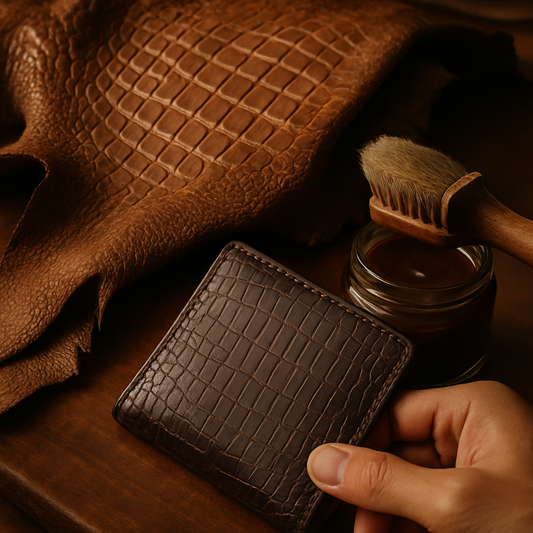
Use a dry, soft cloth to remove surface dust after use. Keep the item away from prolonged water exposure, strong heat, direct sunlight, and damp storage. Do not apply household oils, alcohol-based cleaners, or an untested conditioner, since products can alter the finish and color.
Store the item with enough support to prevent sharp creases, and avoid placing heavy objects on structured pieces. There is no useful fixed cleaning schedule for every crocodile leather item; frequency depends on handling, climate, finish, and visible soiling. If the surface becomes wet or develops a change in finish, ask the seller or a leather specialist before applying a product.
Styling Australian crocodile leather
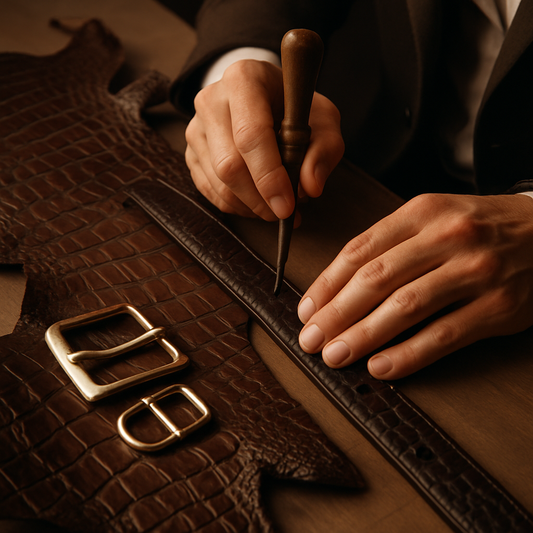
A crocodile belt can work with plain trousers and a simple buckle when the scale pattern is the main texture. A wallet or cardholder can coordinate with shoes through color family rather than an exact skin match. For a bag, subdued clothing can keep the leather’s pattern central, while a patterned outfit may work better with a smaller crocodile accessory.
Color, scale size, shine, and hardware all affect how visible the leather looks. A matte finish and smaller accessory can suit business settings; a larger pattern or higher sheen may be more noticeable in evening or casual styling. These are practical styling choices, not rules about authenticity or value.
Frequently Asked Questions
Is Australian crocodile leather always from saltwater crocodiles?
In commercial usage, “Australian crocodile leather” generally refers to saltwater crocodile, Crocodylus porosus. Australian freshwater crocodile leather is a separate category with a commercially unviable trade, so buyers should still request the stated species.
Does CITES paperwork prove that a crocodile leather product is Australian?
No single document should be treated as proof of every product detail. CITES documentation supports legal trade, while product-specific traceability and the seller’s description are needed to assess species, origin, and the finished item.
Can scale pattern prove that leather is Australian crocodile?
Scale pattern alone cannot establish Australian origin or authenticity. Crocodile patterns vary by species and individual hide, and sensory-pit markings can differ by species and body area.
Is belly-cut crocodile leather a particular grade?
No. Belly cut identifies the underside section of a hide. The leather’s usable area and appearance depend on scars, blemishes, scale layout, finishing, and the grading definition used by the supplier.
Browse CrocodileViet’s crocodile leather collection to compare available product details and construction. For sourcing or sizing questions, contact CrocodileViet through WhatsApp.